Category Archives: Apps EN
Droiders develops the first application in the world to view television on Google Glass for RTVE (Radio Televisión Española) #throughglass
Wednesday
18
Jun
Droiders has developed the first application in the world to view Television through on Google Glass for RTVE (Radio Televisión Española) #throughglass.

Thanks to TVE hedging their technological bets and placing their faith in Droiders to produce this application, we have reached a technological milestone. As a first for the media industry we are able to offer multi device content: from traditional television, to computer, to smartphone, to tablets and now on Google Glass.
This video shows the content available as of today #throughglass
Wearable technology is upon us producing a revolutionary effect in society by manifesting itself in our daily lives. The smartglasses from Google are just a first step.
You could be on a train or a plane journey, pop on your Glass and watch from any of the TVE channels: La 1, La 2, TDP and Canal 24 horas at any time of the day.
It’s very easy to use: you only have to load up the application, select the channel you want to view and click play. Simple as pie.
Do you want to load the RTVE.es Glassware?
If you have Google Glass, you can load up the RTVE.es Glassware
A political convention broadcast through Google Glass – a world first
Monday
03
Feb
Gracias a la colaboración de Droiders, la pasada convención nacional del Partido Popular celebrada este fin de semana, ha sido retransmitida a través de las Google Glass siendo la primera convención de un partido político retransmitida a nivel mundial a través de este dispositivo. La convención ha podido seguirse en directo desde cualquier lugar del planeta desde la página web del partido.
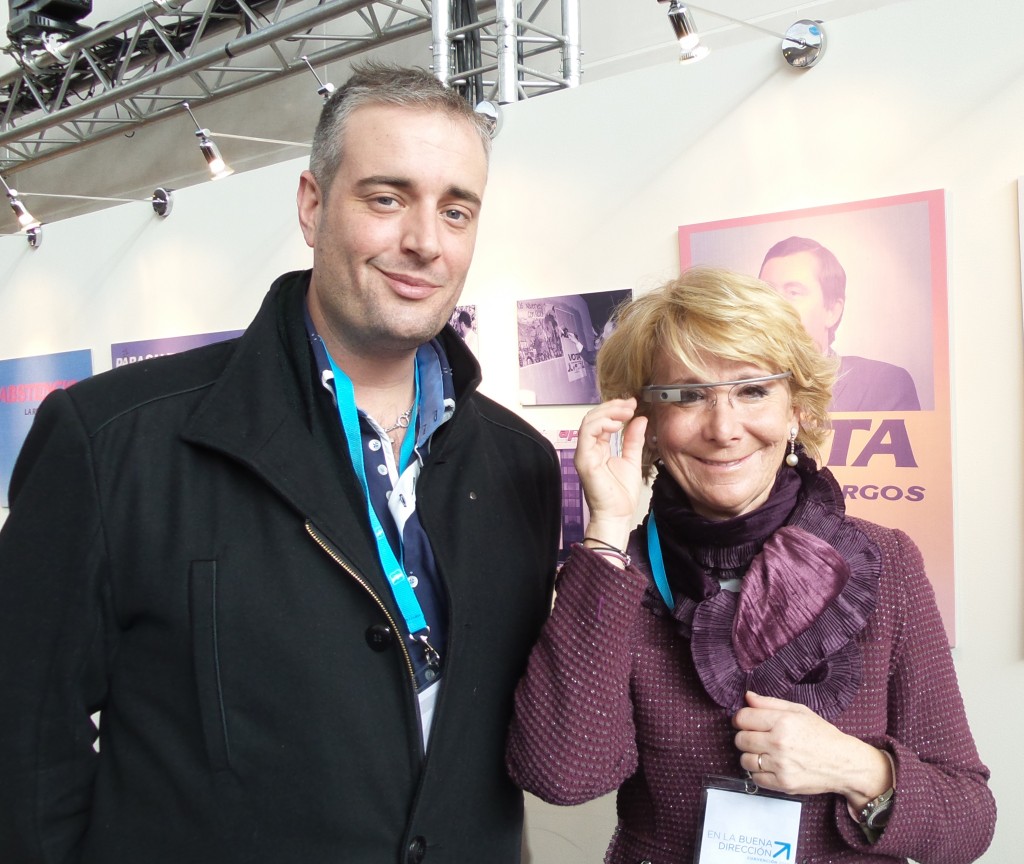
Nuestro director comercial, Ignacio Navarro, junto a Esperanza Aguirre
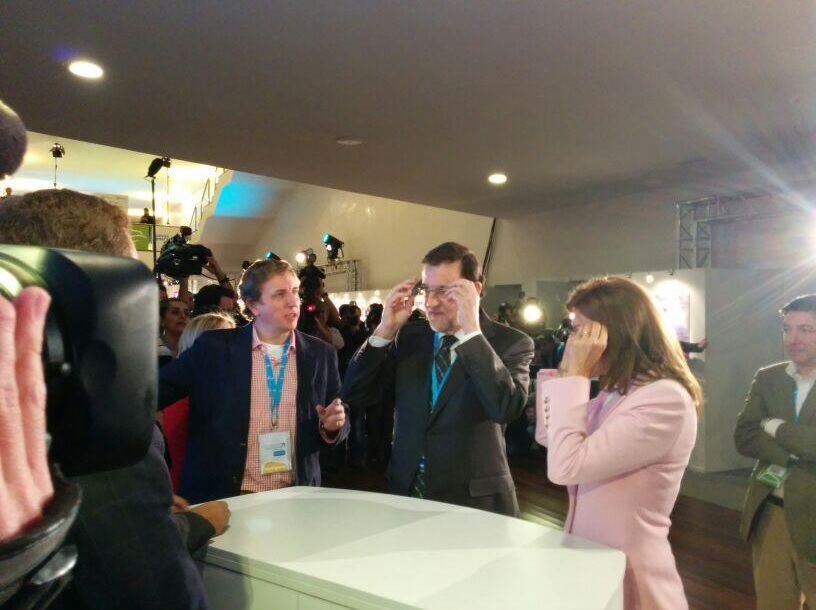
Mariano Rajoy y Mª Dolores Cospedal
Además, diversos cargos del Gobierno, entre ellos Mariano Rajoy y Mª Dolores Cospedal, han podido probarse las Google Glass y conocer todas sus funcionalidades y características.
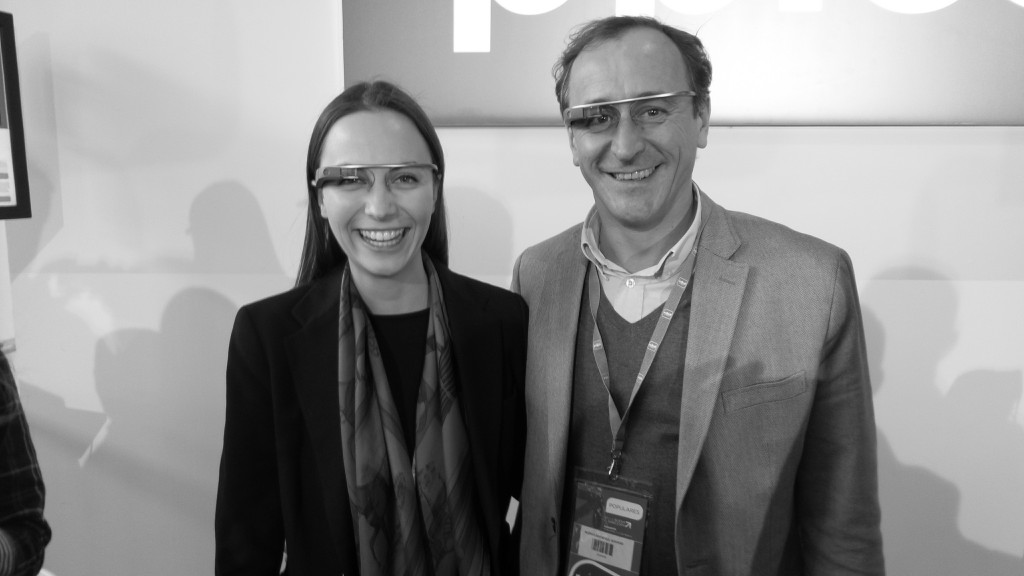
Eva Paunova y Alfonso Alonso
January 2014
Monthly Archives: January 2014
Google Glass and tourism at FITUR 2014 with Droiders
Wednesday
29
Jan
Last week, during 2014 FITUR (Feria Internacional de Turismo en España), Droiders presented new technologies in the field of tourism to improve hotel user experiences. Google Glass really stole the show in terms of the attention garnered. Below are a selection of articles that featured Droiders and Google Glass.
This entry was posted in Events on .
Wearable technology
Monday
27
Jan
Article is reproduced in PDF format with permission from El País Semanal. View below, open in Google Drive or download the PDF.
This entry was posted in Wearables EN on .
Droiders en colaboración con la Comunidad Valenciana presenta en FITUR las últimas innovaciones tecnológicas adaptadas al sector turístico y hostelero
Monday
20
Jan
- Julián Beltrán, CEO de Droiders, dará una conferencia titulada Google Glass: la revolución del turismo, sobre el nuevo dispositivo de Google.
- Los asistentes tendrán la posibilidad de probar el innovador dispositivo de Google Glass y conocer todas sus funcionalidades.
Desde el 22 hasta el 26 de enero estaremos presentes en FITUR presentando todas las funcionalidades de las nuevas tecnologías en el sector turístico y hostelero, especialmente, las aplicaciones creadas para Google Glass que mejorarán enormemente nuestra experiencia turística.
Además, Julián Beltrán, CEO de Droiders, dará una conferencia el día 24 a las 13:00 horas en el pabellón 10B03 titulada Google Glass: la revolución del turismo, sobre los cambios que el turismo vivirá en el futuro gracias al uso de este dispositivo, y enmarcada en el programa de FITURTECH.
Presentaremos además, en exclusiva, algunas de nuestras aplicaciones especialmente preparadas para llevar el turismo a un nivel superior, lo que es conocido como Turismo 3.0. Domótica y realidad aumentada, entre muchos otros, son algunos de los campos en los que hemos desarrollado aplicaciones cada vez más innovadoras que cambiarán completamente nuestra forma de viajar y de percibir el mundo.
Por último, Droiders ofrecerá al público en primicia la oportunidad de poder probar las Google Glass, conocer todas sus características y utilizar todas sus aplicaciones. Una oportunidad única ya que este dispositivo todavía no ha sido puesto a la venta y Droiders es la primera empresa española dedicada a su desarrollo.
This entry was posted in Events and tagged domótica, fitur 2014, fiturtech 2014, Realidad aumentada on .
Digital Trends and wearables – the 2014 view from SAScon
Friday
17
Jan
SAScon is an online marketing conference held in Manchester, UK, that unites the agency marketing community to chew the digital fat, debate online modern marketing issues and latest trends.
Given the marmite like reaction to wearables and in particular to Google Glass, I thought it might be interesting to gather a two bit straw poll of marketing community opinion about Glass during Mini SAScon on Friday 17th January to reflect views from leading agency marketers and online profesionals.
Take a moment and answer these two questions:
I will be taking part in a round table discussion of digital marketing trends for 2014 and look forward to meeting old friends and new faces.
And yes, I will be wearing them, so you’ll recognise me even if you have never seen me before.
A heads up….this post will be updated with video, quotes and more during and after Friday 17th.
To stay informed or be featured here Tweet @paulgailey ping me on Google Plus, or leave a comment below.
Or if you are feeling really uber, answer my question on Jelly.
This entry was posted in Wearables EN on .
Jelly, feta cheese and the future of the ephemeral wearable web
Wednesday
15
Jan
When Twitter came to light in 2006, few people took it seriously. Until SXSW of 2007 it didn’t truly enjoy mass use. Furthermore, Biz Stone, the co-founder of the service was told on occasion that twittr, as it was initially known then, was fun but not particularly useful.
Neither is ice cream. So what if it’s just fun?
Well last week, in addition to the blitz of news about wearables from CES 2014, saw the launch of a new service from Biz Stone, called Jelly.
Jelly is an app that defines itself as a new way to search which feeds off your social contacts. It’s a kind of conversational search engine.
Jelly is an app for iOS & Android.
Although, for now at least, you cannot do a search in the classic sense as we are used to.
You connect to Jelly with Twitter or Facebook with your mobile, you ask a question with a photo and you throw it to the stream.
Point. Shoot. Ask.
Jelly feeds off your pesonal social network although it does not pretend to be a standalone network in itself. Here nobody has a profile and so there is no mad rush to register one and attract followers of sorts.
You can reply to questions with text, with a link and you may also draw an answer with your finger.
I’m not going to dive into detail how the app works, there are already tonnes of posts on tech blogs explaining how to use the service, it’s limitations and it’s potential.
Some compare it to Aardvark, which Google acquired then closed down, with Quora but more visual and quick, with Yahoo Answers but with more credibility, with Google Goggles but more socialble.
The fact is the place is not even a week old and there are already thousands of questions in Jelly about how it should evolve to serve users. Things like hashtags, search functions, tags, if brands should be active and how, and so on.
As always, when early adopters get to grips with a new app or service, the place tends to become saturated with conversation about the service itself in a meta kind of way.
A source of empathy?
Despite the criticsm and comparisons – something that all apps go through at the start – one thing that caught my attention was the statement (expressed in more detail on Techcrunch) from Stone that Jelly aims to generate empathy.
Some have asked why is Jelly would triumph where other Q&A services have not, or what utility does this app have that others do no, or why should we further fragment even more our attention with yet another service or app, when nowadays we have gajillions for every possible scenario.
It’s evident that it is ever more difficult to compete for users’ attention, that there is an avalanche of content and at the same time, there is a boom in sites that aim to serve the ephemeral web – Snapchat, Vine, Tumblr and more – sites that where a delightful user experience with content that is close to your interests and aligned with your social graph, encourage a feeling of empathy and capture precious user attention however fleeting it may be.
Where does Jelly fit in?
If you have used the app or you feel bombarded by questions and all sorts of random encounters, you may be asking yourself the same thing.
And yet, on the official Jelly blog, they explain what is their use case vision of the site. Citing Einstein, Jelly’s goal is that we apply our collective wisdom and experience to help other, over simply spreading information.
Despite that, it appears there are many questions on Jelly that do not necessarily follow the example in the explainer video, where Biz finds himself infront of a work of art in a forest, he takes a pic, and feeds the stream to fathom the mystery of the object.
Questions such as where am I?, who is this? is this person attractive? and such, that now exist in abundance on Jelly, or those questions that only seem to be designed to generate interaction, are perhaps not the finest use case examples of the platform.
What is clear is that people are experimenting with how to use the platform and checking if it is likely to evolve with any more sophistication.
The Jelly power user
Out of sheer curiosity, Droiders also joined in, popping a question to the flock of early adopters by asking: how many apps do you estimate you have installed on your mobile? just to check if the average for the early Jelly users is significantly different to that average as described below that we also blogged about last week.

And despite receiving responses almost immediately, we are aware that, maybe in the longer term, this is not the place to poll user opinion.
By the way, the average number of apps installed by jelly users, in this case was 68 compared to the Statistia 26 of the infographic as published in Mashable as shown above.
What is the meta with feta on Jelly?
For each question posed on Jelly, no matter how serious or flippant, there are all sorts of replies and of course, sarcasm and absurdity are never in short supply.
Maybe the most widely repeated to date is the case of the feta cheese answer that some have dubbed spam in everything but name.

If you have not come across feta cheese whilst using Jelly, perhaps you have been lucky (or not?) or you simply have not swiped away enough questions.
And yet, in the case of the feta cheese replies, there is a more subtle force at work and we can reveal how it really came to be and how the fate of feta has evolved.
Having my mobile in my hand whilst I boiled the kettle for a quick unglamourous yatekomo snack (think freeze dried noodles with a sachet of flavouring) I throw out this question via my personal Jelly account.

Note: yatekomo (sic) is a fictious mispelling of the phrase in Spanish which roughly translates as – I’m about to eat
you, but as pronounced in spanish it has a fun sort of far east oriental accent sound to it when repeated quickly.
It’s onomatopoeia is, dare I say it, exquisite.
And long behold, in response to my mildly inane Jelly query, I received an answer of feta cheese, which just about qualifies in this context as an accurate answer as it is a word pun on the sound of the word fatter.
OK, not strictly a brand name which I was asking about, but not too bad nonetheless for a fleeting chuckle.
A little later, I noticed that each time I attempted to answer a Jelly question, the app would struggle to eliminate the previous answer in the cache, and I would inadvertently answer a question with the previous answer to a wholly unrelated question.
The app was buggy and sure enough my Android device duly updated itself with a new iteration of Jelly several times in those first few days of activity.
Maybe the same issue afflicted Lee Stacey who with uncanny coincidence therein after, began answering questions with the same absurd answer of feta cheese.
Pretty soon a deluge of feta cheese answers inundated Jelly to the increasing chagrin and bemusement of fellow users..
And so it continued with no sign of a user ban in store for Mr Stacey.
To the point that some openly doubted if feta cheese were actually a brand trying to muscle in on the action:
The reality is that in all probability, feta cheese is a mild form of silly protest against those questions that do not meet the expectations of the platform, let alone the standards of Einstein.
Take a look at a tweet of our friend Lee offering a hint of an explanation in a polite exchange of thoughts with another Jelly user:
@saturngirl Which is not the case for many of the answers (or questions) on Jelly thus far. I shall consider your whim, though.
— Lee Stacey (@LStacey) January 12, 2014
Maybe we need to look beyond Jelly to really understand Lee’s motives.
That said, if you want a real deep dive of the user behaviour data that Jelly users have left in their wake, take a look at the excellent RJMetrics blog piece.
Absurdity is big business
So if empathy is an brand goal which offers value, companies graft it every day and earn it, not only with high quality production ads, lower budget efforts on YouTube or in tweet exchanges with famous celebrities with powerful followers.
@raquelsastrecom haremos todo lo posible para normalizarte como deseas Raquel… “We have the technology” -pg
— Droiders (@Droiders) January 10, 2014
Translation: @raquelsastrecom At long last I feel like a normal woman, I am really excited because tomorrow I am going to try on some new glasses. Google Glass !! @droiders
@raquelsastrecom we will do everything posible to normalise you as you so desire Raquel…”we have the technology” -pg
Ojo @raquelsastrecom que tendrás que pasar primero por el laboratorio http://t.co/QdQWt9w2Uv antes de que te lleves las Glass. -pg — Droiders (@Droiders) January 10, 2014
Translation: Lookout @raquelsastrecom you will have to first pass through the lab before you can leave here wearing Glass.
Huge tech brands that perhaps you do not immediately associate with the absurd, infact devote part of their marketing efforts wholesale into ridiculousness, so they can, according to them, and I quote:
compete with your wife and doughnuts for your attention.”
In this recommended Social Pros podcast, Tim Washer, a consultant for Cisco, explains to Jay Baer of Convince & Convert, how the stateside manufacturer of routers uses humour to connect with their b2b audience to indeed open doors to sizeable sales deals.
And the absurd is not at all reserved to a few daring brands and geeks who use shiny new apps in an unconventional way. Only this week No Pants Subway Ride was celebrated in cities all around the world including here in Madrid.
So what role do wearables have in all this?
Wearable tech not only allows us to enjoy contextual utility at any given moment but it also enables those moments of total human expression to be seen and shared from the faithful perspective of the wearer, allowing those instants to be captured for posterity.
How many times has that opportunity to seize a photo at a critical moment escaped you, which, even if you had whipped out your mobile quickly, you would simply not have captured it in time?

That photo above was captured with Google Glass. Hands free, in the zone, without a contrived pose or expression in sight.
Wearables allow us that and more. With minimum effort and intrusion we can take a photo and share it, or even ask our network, in a mere few seconds.
And so whilst it remains a tad early to venture the possibility – as there is no formal Jelly API at the moment – I will end on one final thought or indeed pose the question, naturally, in a picture below, itself worth more than a thousand words.


This entry was posted in Wearables EN on .
ok glass, undoom
Friday
03
Jan
¡Stop Press! Glass is doomed.
“Google Glass is doomed.” In 2014…says the headline.
So, they say, or so they say, they will say.
Well I’ve done the maths.
Er…fuzzy maths, based on the tweet reaction to Robert Scoble’s widely reported latest comments about Google Glass for 2014.
Actually, this is a little more than a quick snapshot from Topsy, comparing the mentions of Doomed versus Doomed 2014, and the ratio of the former to the latter, is about 2.9, so roughly speaking, two in three mentions of the blog post are misquoting Scoble.

And of course, if you believe what you read, Google Glass is doomed.
As Robert himself wryly admits in his opening paragraph, he loves a headline like anybody else. And so indeed do headline writers, much to the chagrin of a source or a PR team.
@EverydayDigital don’t believe what you read. Google Glass is HOT on the streets. So many people want it.
— Robert Scoble (@Scobleizer) May 22, 2013
If you can’t filter the signal from the noise, then Scobleizer’s doom quote therefore becomes a little warped and he’s no doubt used to that and thrives on the debate – he admits as such in the comments on @andrewgrill’s post which deals with the influencer aspects of cognoscenti and evangelism marketing.
I disagree this is about an influencer management issue. Cat herding is notoriously tricky and some companies do not truly go there.
So how could someone who taunted us so convincingly that he would never remove Glass, even for an infamous near selfie in the shower, could now go so cold on Glass?
Allow me to offer a different photo please.
‘Over? Did you say ‘over’?
The doomed reality scenario is infact more nuanced with Glass and if you read beyond the headline, or the retweets and if you observe over time, you may reach a more balanced conclusion.
I suspect this public display of a quasi trough of disillusionment, is more than, just that, and whilst Andrew Grill makes some interesting observations about the influencer management aspects of it, the tech press reaction to Glass has been decidely mixed throughout 2013.
It’s plain to see that pundits and press are not always on the same wavelength.
@mikebutcher to be fair, I think @Scobleizer is saying it’s ‘doomed’ in 2014 rather than overall. He’s frustrated by its slow dev pace.
— Martin Bryant (@MartinSFP) December 31, 2013
Despite, Martin’s measured take on it, evidently the sparring goes back some way.
Why Google Glass isn’t a Segway and why Mike Butcher is wrong. https://t.co/3BhHPpM1ek — Robert Scoble (@Scobleizer) April 28, 2013
Heck, you only need to read as far as the second paragraph in TNW article to realise that when Scoble says it’s doomed, it’s because the tech press tells him so. Infact Scoble has gone on the record to express what he considers Google Glass as a success and despite the misgivings it’s obvious he maintains a belief in the promise of the device:
With the possibility of a wearable device from Apple emerging this year, it’s clear that the subject of wearables will make acres of tech column inches – with inevitable comparisons between devices from tech giants – there are already plenty of Glass alternatives from crowd funded devices to lesser known brands, and yet the b2b market for wearable may not be with us for a while yet.
@skaragiannis Google Glass in enterprise? That is a 2015 thing
— Robert Scoble (@Scobleizer) August 29, 2013
Indeed other commentators don’t expect the wearable curve to really hockeystick for a while yet.
Business Insider – Google Glass Sales Projections
The Droiders team have been privileged to develop Glassware and proper meddle with device since Q2, 2013 and continue to sense a rabid enthusiasm for Glass from the general public, tech professionals and clients alike.
If we’d believed everything we read, we might have thought that Augmented Reality was not possible with Google Glass, when infact, it was back in August.
Had we not pursued the limits of Glass in early summer 2013, we may not have enjoyed watching a blind person use Glass to read signs on prime time TV or enabled pioneering surgeons to operate wearing Glass.
And while both of these Glassware deployments are nascent, like other Glass developers, we’re developing them to meet client demand in 2014.
Is Glass perfect yet?
Nope, of course not. It’s in beta so to speak. A prototype. With less of a distribution than other infamous Google betas (Gmail was 5 five years in beta), it is constantly being iterated on.
Like other developers, we have provided feedback through official channels to Google and it’s clear the product has a way to go to satisfy all demands. But let’s not forget the software at XE12, has on average been iterated each month and huge strides are being made, especially as the recent GDK allows development access to native sensors of the device.
Only this week, the device became more available to new users as Glass distribution steadily increases with the invitation to purchase Glass for Google Play Music All Access users.
Does the Glass criticism stand up?
Whilst we’re not here to dissect each line of Robert’s post, some things do stand out that are worth a rebuttal.
Where’s the Foursquare app? – Dennis Crowley has already said on the record, that Foursquare will not be available on Glass. Yet. He’s also said about a year ago in Barcelona’s MWC: “Anywhere there’s a screen, we want to put our stuff on it, whether that’s on a phone, or a watch, or whatever.”
Battery life – Granted the battery life is not comparable to a smartphone – and nor would anyone reasonably expect it to be. There are third parties toying with extra battery pack add ons, and you can charge the device on the go if you want with a portable battery as many do.
Not enough apps. UX cannot handle lots of apps – Fair point. If you’re an appovore that is and want to install three hundred apps. Not everyone packs in hundreds of apps to their smartphones. Regular users infact only install about 26. But we get your point, the UX is not perfected for app selection from masses of Glassware. Yet.

And yes, the official distribution for Apps, excuse me, Glassware, is still in it’s infancy, with only some thirty or so official top flight big brand Glassware available in the boutique store of google.com/myglass whilst the others, that we estimate from the likes of unofficial Glass directories like, Glass Apps, to number in the hundred or so, are only available as sideloaded APK files.
The development of the store and inclusion of more high quality apps will only increase as developers iterate their Glassware. But be aware, many are devising Glassware for b2b and niche usage, and not necessarily chasing a b2c elusive glory of a consumer app to compete with Angry Birds™.
Photo workflow sucks – Well, kinda. I thought that at first, but then again, you do reset your expectations and behaviour with Glass. No, you don’t enjoy full media editing within Glass. But after a trip with them on, and taking a succession of photos and videos, I was unexpectedly offered by Google, a neat little video and photo montage set to music of the whole experience.
So it was through the Google Plus account that this happened with the auto-awesome (love the effect, not the vernacular) film offered to me. The joy and convenience of that nullifies the expectation limitation we can inadvertently set ourselves for Glass. It’s a companion device at the end of the day.
No contextual filtering. Google Glass desperately needs those contextual signals to know when to show you appropriate stuff – Some of this is already handled with the ever learning Google Now and more of it is possible with highly refined Glassware. Context aware Glassware is a win win for everyone and we agree it’s only the start.
As to if Glass will be a success by 2020, that date is seems an eternity away in tech terms and I think comparisons with the Apple Newton and how long that took, before, it morphed to the iPad and achieved phenomenal success are bordering on the pessimistic.
I asked a couple of leading Glassware developers their opinions of the state of Glass going into 2014.
Cecilia Abadie of Byte an Atom in San Diego ,known as the developer behind Genie App for Glass, co-founder of LynxFit and also the recipient of the now infamous fine whilst driving with Glass, and more recently on the cover of a Yahoo story about Glass in 2014 had this to say:
For us as a startup trying to help people on their path to health and fitness, Google Glass is the best device today and looking forward into the launch on 2014. There is no other sensor loaded hands free device that can bring workouts to people’s lives in a seamless way, using natural interfaces such as voice and touch and liberating our users from ipads and cellphones that completely disrupt their flow.
Adoption is obviously unpredictable and very arguable at this early point, but from our perspective at Byte an Atom Research, we’re betting strongly on wearables and specifically on Google Glass. We also are big believers on Glass for vertical markets and we believe although it’s early for the ecosystem to be mature it’s getting there. We need to take into consideration that the GDK was launched very recently and that will unleash developers potential.
Noble Ackerson, also of Byte an Atom, the developer behind the Glassware lynxfit.com which is a fitness app for Glass, comments:
I think it’s bordering on pre-mature at this point to count Glass out as gloom. With that said, I am waiting for Google to provide a distribution channel for my app as well so I agree with the distro point.
So is it doomed? In 2014?
@ryan the critics of Glass are very wrong, very wrong indeed. This is a magical product. Life changing.
— Robert Scoble (@Scobleizer) April 27, 2013
Ultimately the omission of the date of 2014 to this Glass story, can as with any date sensitive remark, massively alter interpretations.
Ask any media pro and they’ll tell you. Even hardened media campaigners on the receiving end of a journalistic probe, like the disgraced rider Lance Armstrong fell prey to it.
This summer just gone, only days before the centenary Tour de France, he declared to french journalists, that it was impossible to win the Tour [during the period 1999-2005] without drugs, and of course that date part was conveniently omitted or misreported for all manner of mayhem to then be unleashed.
But I digress, the nub of the argument here is that the other wearable elephant in the room that has yet to reveal it’s stripes.
And given this is the Age of Context, I don’t regard this outburst as an outright dismissal of Google Glass, nor is it a public blogger relations breakdown.
Apple will invariably make waves when it shows its hand with a retail distribution advantage and latent goodwill awaiting it’s any new product launch, and herein lies the issue, that metaphorical apples and pear wearables will be compared. Unfairly perhaps.
So does that mean Glass is doomed?
I don’t think so.
Do you?
This entry was posted in Droiders EN on .
(Español) Mañana en El Hormiguero presentamos la primera aplicación del mundo que permite la lectura a invidentes con Google Glass
Droiders en colaboración con la Comunidad Valenciana presenta en FITUR las últimas innovaciones tecnológicas adaptadas al sector turístico y hostelero – Droiders
Droiders en colaboración con la Comunidad Valenciana presenta en FITUR las últimas innovaciones tecnológicas adaptadas al sector turístico y hostelero
Monday
20
Jan
- Julián Beltrán, CEO de Droiders, dará una conferencia titulada Google Glass: la revolución del turismo, sobre el nuevo dispositivo de Google.
- Los asistentes tendrán la posibilidad de probar el innovador dispositivo de Google Glass y conocer todas sus funcionalidades.
Desde el 22 hasta el 26 de enero estaremos presentes en FITUR presentando todas las funcionalidades de las nuevas tecnologías en el sector turístico y hostelero, especialmente, las aplicaciones creadas para Google Glass que mejorarán enormemente nuestra experiencia turística.
Además, Julián Beltrán, CEO de Droiders, dará una conferencia el día 24 a las 13:00 horas en el pabellón 10B03 titulada Google Glass: la revolución del turismo, sobre los cambios que el turismo vivirá en el futuro gracias al uso de este dispositivo, y enmarcada en el programa de FITURTECH.
Presentaremos además, en exclusiva, algunas de nuestras aplicaciones especialmente preparadas para llevar el turismo a un nivel superior, lo que es conocido como Turismo 3.0. Domótica y realidad aumentada, entre muchos otros, son algunos de los campos en los que hemos desarrollado aplicaciones cada vez más innovadoras que cambiarán completamente nuestra forma de viajar y de percibir el mundo.
Por último, Droiders ofrecerá al público en primicia la oportunidad de poder probar las Google Glass, conocer todas sus características y utilizar todas sus aplicaciones. Una oportunidad única ya que este dispositivo todavía no ha sido puesto a la venta y Droiders es la primera empresa española dedicada a su desarrollo.
This entry was posted in Events and tagged domótica @es @en, fitur 2014 @es @en, fiturtech 2014 @es @en, Realidad aumentada @es @en on .
Announcements and opinion from team Droiders
Category Archives: Droiders EN
China #throughglass: What Chêng Ho teaches us
Friday
19
Jun
Looking at the world #throughglass, it is known that the search of objects such as The Ark of the Covenant, Merlin’s Wand, Excalibur or of mythical places like El Dorado, Shambhalla or Atlantis, has long encouraged all sorts of sincere entrepreneurial truth-seekers and neo-gurus. There is nothing new about this; ever since “Man” – and of course, “Wo-Man” – were able to say “I Am”, there has been a search for meaning, for answers. In the world of today’s turmoil, there is only a different language to express all this.
Let us read an example. In the year 1433 AD, Chêng Ho (Zheng He), born of a Muslim family from southern China and a top-notch Imperial Court’s eunuch, had returned home due to the new Emperor’s strict policy forbidding the Chinese from traveling abroad. His birthplace, Kunyang, is a 900-km (550-mile) drive to Droiders’ office in Shenzhen along the South to the East China Sea.
Admiral Ho established diplomatic and/or tributary relations with peoples ranging from Nanjing (northern China) to Kochin (southern India) to Mecca and down to Mogadishu (actual Somalia). The Indians, Persians and Arabs could not envisage how the most powerful naval force known to that day, a 27.000-man crew with mastodonic nine-mast four-deck ships, was used primarily for exploration and seafaring. Now, that was truly a search for the Grail of trade and meaning!
Back at home, the same story: an old battle between Confucian bureaucrats and Court eunuchs.
What should we learn, not from Admiral Ho himself but from the new Emperor’s attitude? This is to say, how upper management in companies across the market board must find means and meaning by being ready and up for the challenge; this is one of the issues we address at Droiders, every day: our product, Streye, is the means as those ships and firmness of purpose were for our protagonist. How reinvestment, effort, the search for technical perfectibility and the Herculean challenge of human reason produce the best results. These are the questions people like Chêng Ho have to master: a sense of enterprise by looking at China and the world #throughglass. If you are a Google Glass explorer just go ahead and feel free to do it!
“Let a thousand flowers bloom, a hundred schools of thought contend“, said Chairman Mao Tse-T’ung. After him, he Chinese started in quite a different way where Chêng Ho had been compelled to leave off.
Here is the moral (and the morale) of this piece of history: Admiral Ho and his vast fleet could have “discovered” the European continent, had they been able to carry on. Then, sixty years later the Treaty of Tordesillas and Vasco Da Gama opened the way for Europeans to “discover” China in 1513 AD…
… the new Emperor should not have listened to mere bureaucrats.
This entry was posted in Apps EN, Development, Droiders EN, Google EN, Google Glass and tagged broadcast, Explorer, Google glass, meta glass development, Realidad aumentada, streye, Streye Live on .
A Day at Droiders: Smartglass and Wearable Technology
Friday
08
May
We are located in Murcia’s financial district, it’s 8:30 a.m. and Droiders opens its doors. When the lift doors open, the first things we perceive are a delicious smell of coffee and laughter. So, as we enter a wide open-plan office, we gape at the biggest Google Glass in history hanging from the ceiling. This is how work starts at Droiders every morning, having breakfast while gazing at a spectacular view from the tower, where Droiders headquarters are.
Droiders Headquarters
After a quick coffee together, the Development team crosses a hallway into the heart of the company. This is where engineers, designers and developers work on Augmented Reality software and hardware, such as Epson Moverio; Virtual Reality and cutting edge wearables.

Around 9:30 a.m., after spending some time in front of a computer screen, the Marketing team enters the Meeting Room; they report on daily subjects and objectives as well as feedback on yesterday’s work. An overhead projector turns on and, from a pair of Google Glass in which there is a Streye Checkr tasks list, starts showing slides; in order to achieve this, we use Streye Live Pro, a smartglass software we have designed, developed and patented ourselves. Then, today’s subject turns out to be about the strategy and campaign of our new product. After the meeting, the team returns to its section, moving forward with new ideas for the project.
It’s 11:00 a.m., time for a quick brunch. You see people walking back and forth from all directions. Some take over the kitchen to get toasties ready, while others take advantage of having a pair of Oculus Rift goggles to leave this world for a brief time. They become immersed into a virtual world. Then, there is a Formula 1 Race challenge, to find out who’s fastest…and who will have to bring food for the rest!
Immersed in a Formula 1 Race
A visitor comes into the office; senior managers and clients head for the Meeting Room. All the rest return to their posts so to keep working on new concepts, on developments that shall bring the future a bit closer. The streets are about to be invaded by devices way beyond smartphones. Wearables are clothing that store, broadcast and receive information. Hyper-connectivity is here to stay.
Lunch is here! There is an avalanche and people cue for two microwave ovens; the open-plan office is empty. Now food tables are the place to be. Comments and laughter between bites and mouthfuls. A courier service package arrives and one of the engineers opens it as was typical of Steve Jobs, and he introduces a brand-new smartwatch being long awaited by the team.
It’s 3:30 p.m. Two more hours to go in which the design and Web usability teams work on the web pages and display banners to be used in the commercial campaign. Marketing analyses performance, past and present. Just before off-duty time, the last meeting of the day, commenting on real-time results and tomorrow’s objectives.
At Droiders, our sights are set on that which exists though always looking at what is to come. By working here, one realizes that the future is not far from the present. It is right here, within the following minute and we are heading straight into it.
Droiders ¡Performing Apps!
- Oculus Rift Simulator
This entry was posted in Droiders EN and tagged Droiders, Droiders, empresa, epson, murcia, Oculus, smartglass, streye, streye, Tecnología, wearables on .
Truly “Immersive” VR: Sharing Droiders vision
Tuesday
28
Apr
It was a steamy, sunny south-Florida Saturday afternoon; some neighbors had carried all sorts of items out to their own front yards for a typical Yard Sale. I happened to walk by and decided to snoop around. A Betamax player from the 80s, a whole stack of John Deere t-shirts…and some books. I had to buy me at least one of those t-shirts! The book section was quite uninteresting to cherry-pick from, except for one first-edition book I happened to bump into: The Second Self: Computers and the Human Spirit.
Something clicks inside when you read a title like that. The book’s authoress was Dr. Sherry Turkle, Director of MIT Initiative on Technology and Self
Program in Science, Technology, today. I bought that old-time hardcover for pennies and this is what I read in the Introduction: “Technology catalyzes changes not only in what we do but in how we think. It changes people’s awareness of themselves, of one another, of their relationship with the world…It challenges our notions not only of time and distance, but of mind.” This was written in 1984.
Chatting about ‘immersion’ and how Virtual Reality (VR) jostles our minds, it is easy to extrapolate on how it may affect education. For those of us who consider education as the backbone of the future, VR is much more than just a way of escapism as we have seen in most sci-fi films. Droiders is also developing on Oculus Rift for more than one purpose: that is called Corporate Social Responsibility.
We at Droiders, in the same way as Palmer Luckey, Founder of Oculus VR, share in that adventure: to positively enhance human capabilities. Wired magazine article on Mr. Luckey testifies to this upcoming, catalyzing and immersive mission to enrich minds by raising unusual questions.
This entry was posted in Apps EN, Development, Droiders EN, Google EN and tagged CSR, Forbes VR, human spirit, immersive vision, immersive VR, MIT Turkle Technology, oculus glass, oculus healthcare, oculus rift, Oculus VR, Palmer Luckey, renault vr, Sherry Turkle, the second self, Turkle, Wired VR Luckey on .
Of New and Old Signs: AR, VR and the core of it all
Wednesday
22
Apr
In Hoc Signo Vinces, “In this sign, conquer” reads the translation into Latin in historian Lucius Lactantius’ account of Emperor Constantine’s vision of the Chi Ro (Chrismon); our dear Emperor was not a Christian per se though this event of the invisible did leave an indelible mark on his soul – you may not believe this – which single-handedly changed the history of a continent, and the world as well. This sign inspired him to win a great battle.
For those of us who work – and feel passionate about – the field of the intangible, that is, the internet of everything, we need signs to understand and meet such feats. Here is a way of hinting at them: University of Toronto Professor Derrick de Kerckhove, the philosopher and champion of emerging media, offers three distinctive signs on his milestone book Connected Intelligence: The Arrival of the Web Society; they are known as Interactivity, Hypertextuality and Connectedness.
Thus, in this day and age, what would be the signs through which we shall conquer? And, actually, what is to be conquered and which battle? Now, that’s a question to take to bed every night. Let’s be pragmatic!
We should think of Interactivity as the “body” or physical linking of people; Hypertextuality, the linking of contents or knowledge-based such as the human memory; finally, Connectedness – a term New Agers are so fond of – as the “mental” linking. Interactivity is touch; Hypertextuality is zapped all-encompassing content; Connectedness, the medium (aha, now you recall McLuhan!).
Is it inevitable we portend AR and VR as results of these “signs”? The answer is yes. It’s inevitable. How do I know that? Well, have you ever tried Google Glass? Or a snazzy pair of Epson Moverio glasses? And what about other wearables? They all seem to be “smart”.

If we venture further, we find that even a blind person is able to interact with his/her environment with Droiders’ first-ever ReadAloud OCR (Optical Character Recognition) app on a pair of Google Glass.
As humans, we are accomplishing the extension of our senses into the unseen (just like any mystic used to) just as Constantine once did. We have become more complex. Hail complexity!
This entry was posted in Apps EN, Droiders EN, Google EN, Wearables EN and tagged AR, Connectedness, Google glass, Google glass @es @es @en, Hypertextuality, Interactivity, Kerckhove, meta glass development, signs, smart glasses, VR on .
Streye, the future of your enterprise
Monday
20
Apr
As Tom Clancy once wrote, Technology is a tool that helps us improve our lives. This is why we want to announce that in the next days you wil be able to acquire all our Streye products. We will soon be providing more info on how Streye shall improve performance in your business.
Lets start with Streye Box , the future of medicine. It is a streaming system capable of sending video captures mostly from any source. For example, in the healthcare industry, from an endoscope or an ultrasound device by bradcasting a low-delay video signal using a high quality system into your smartglasses. This system provides multiple advantages, just to mention a few: comfort for the healthcare professional, resource optimization and a clear patient-first focus approach.

Continuing with streaming systems , we have Streye Live, which we wrote about in the previous post. What can we achieve with Streye Live? Live broadcasts to YouTube Live Events. You can tell stories or simply share what you are doing at the moment directly through the biggest online video platform.
Then we have Streye Live Pro, a collaborative streaming tool that allows us to screenshot from your smartglass to another device and viceversa. With Streye Live Pro, we can share documents or multimedia files between both devices. It also allows to look at your smartphone content through your smartglass. For example, if you take a picture with your smartglass, you can securely edit it on your smartphone without having to switch your line of vision from the glass.
Finally, but not the least, we offer Streye Checkr, . This application helps you to create tasks and checklists, collaborating in group to improve productivity. You can attach multimedia files and add information to a task list and share for others to complete it, ensuring great success in any procedure without losing time. It provides and excellent way to follow guidelines.

Streye has been designed to boost efficiency in any business, because it is easy to share work, gain experience, ask for opinion and collaborate in group with our apps. Don’t forget to click on web to get more information about Streye products.
This entry was posted in Apps EN, Droiders EN, Events and tagged Abril, Adquire, Adquirir, April, Augmented Reality, broadcast, Buy, checklist, Comprar, Endoscope, endoscopios, Google glass, Google glass, instrumental médico, Internet, medicina, medicina, medicine, Pro, Purchase, Smartglasses. Epson Moverio, Streaming, Streaming, streye, streye, Streye Box, Streye Checkr, Streye Live, Streye Live, Tareas on .
Announcements and opinion from team Droiders
Category Archives: Droiders EN
Google Glass, more alive than ever
Thursday
26
Feb
Since the news came out that Google closed it’s Glass Explorer program – that’s the name for those users who paid $1.500 to become trialists of the device – many have leapt to the conclusion that the entire project has been canned. Nothing could be further from the truth.

It’s not that Google wishes to sunset the project by any means, the reality is that have graduated to another division, out of Google X under the guidance of Tony Fadell, otherwise known as “the father” of the iPod, and, Ivy Ross, of prior retail fame and success. Fadell aims to position Google Glass as an everday device.
He is counting on the support of the Italian Luxottica giant, the manufacturer of the famous Ray-Ban, Oakley and Arnette sunglasses, to design new frames and materials for a beautiful and desirable end product.
Not all efforts will be focused on the exterior appearance though. Fadell also wants to change the guts of the system, by partnering with the chip giant: Intel. So, where can we expect to notice the change?: in the performance (4 hours more battery life) and a reduced working temperature.
Google’s objective is a Glass that weighs the same as a regular pair of glasses, so for it to be truly wearable it needs to feel part of your outfit.
But alas, this does not rule out developers continuing to develop on the platform. The modification of the hardware aspect of the device will not affect the programming of Glass.

As of now, Glass Explorer Edition is no longer available in United States or UK, the only territories where Explorers could obtain Glass untill now, But those with Glass freely continue to use them and develop on the platform.
In fact, at Droiders we’re developing glassware, and our goal is to keep investigating and working on various projects, just as we have been doing since 2012, speaking at different public events and working on public and undisclosed Glass for work projects.
For example, this week, Julián Beltrán, CEO of Droiders, gave a talk at the second Clinical Simulation Conference held in Dubai, talking about Glass and other wearable technologies in the mhealth sector with Dr. Homero Rivas of Stanford Universtiy Medical Center.
We’ve also recently launched official MyGlass Glassware: Nativo and Streye Live.
Finally we’re also proud to exhibit at Mobile World Congress in Barcelona, March 2-5th in the Congress square Hall, stand CS121 where we will be unveiling even more Glassware. We hope to see you there!

This entry was posted in Droiders EN and tagged Droiders, Explorer, Google glass, Mobile World Congress, Nativo, Streye Live on .
Vaso – for optimists/pessimists everywhere
Tuesday
01
Apr
Life is full of uncertainties.
The ever debated question of which came first: the chicken or the egg, proof of primordial gravitational waves, 42, and other cosmogenic theories.
Then there’s the glass of water, filled halfway: Is it half empty or half full?
Developing Performing Apps at Droiders is more than a daily exercise of contemplating such profound philosophical matters.Tweet
Vaso – more than code
That’s why we’re proud to announce our latest app, Vaso, a practical solution for Voyagers – as Vaso users are known – in need of defining the status quo.
Vaso accurately measures the volume of liquid contained in a glass and returns a percentage fill readout in a gauge display #throughglass.
Vaso unequivocally answers one of life’s most frequently asked questions that has long since puzzled mankind.
Vaso – serving dual audiences
Feedback from Vaso beta testing sessions has proved crucial for iteration of the app.
The production release of Vaso incorporates that feedback and therefore caters for two distinct audiences.
A Droiders spokesman explains:
Vaso version 0.5 – at the time it was codenamed ‘half’ – proved to be divisive in testing, as about 50 per cent of our control group commented that the gauge label readings were consistently inaccurate.
.. it wasn’t so much the calibrated unit centilitres measurement – which was exhaustively verified – but the terminology of the label that the vasoware displayed of ‘full’ which produced all sorts of disputes among the group of early Voyagers.
Solving the outlook for Vaso
Designers from Droiders adroitly addressed the issue by introducing a ‘settings’ menu allowing the Voyager to configure either pessimist or optimist mode.
This switch ingeniously inverted the scale of the gauge and simultaneously swapped the text labels of ’empty’ and ‘full’.
This satisfied both sets of Voyagers whilst maintaining the overall accuracy and integrity of Vaso.
Vaso philosophy
Therein lies the beauty of this vasoware because Vaso is much more than just an innovative way of understanding the fill level of a glass of liquid.
How you set up Vaso is a statement of your outlook on life.
This is vasoware. And for pessimist and optimist Voyagers everywhere, it’s a symbol of individuality and a belief in personal freedom.Tweet
Vaso logic
Vaso is another world first for the team at Droiders based in Europe.
Vaso achieves a high degree of accuracy due to Advanced Processing Realtime Infrared Logic, as devised by Droiders Labs.
The Vaso 50% challenge
So how does Vaso function when faced with a glass with a 50% fill level?
To satisfy both pessimists and optimists, Vaso currently returns a ‘half’ reading, irrespective of the user’s setting.
Crowdsourcing the conundrum
Developers at Droiders remain keen however to tap the wisdom of the crowds to answer the universal conundrum:
Vaso – a clear future ahead
There are compelling opportunities for vasoware deployed in the industrial sector, with the prospect of large scale, hands free, liquid volume inspections.
A retailer version for hospitality business owners to calculate serving yields of alcoholic stock is also being evaluated for commercial demand.
Market research however is strongly suggesting that a consumer vasoware may prove most popular among value for money minded patrons verifying levels of their tantalisingly served beverages.
Can I have a top up? – © Mirror
Indeed advanced vasoware could hail the end of disagreements between bar staff and patrons regarding filled levels of served drinks or satisfy trading standards officers who currently can only act at thresholds south of 95%.
Wine glass fills and beer foam complexity
The performance of Vaso with a glass of water is relatively straight forward compared to the challenges of wine, which is typically not served to the brim.
This poses a problem for Vaso interpretating wine fill level deficiencies outside of the lab where beverage conditions are highly varied.
Piaget Beer Gauge – analogue predecessor to Vaso © Chris Holloway
Beer also has a fiendish trait, frequently presenting foam ratio detection issues, renowned for disrupting the “empty” and “full” scores which can lead to volatile readouts.
“Beer is notoriously tricky… “, states a Droiders spokesperson, and the phenomenon of under serving is indeed a serious matter.
Past efforts to combat tavern injustice include the Piaget Beer Gauge, from the federal research physicist Chris Holloway, whose analgoue invention deploys a mathematical formula in the form of a card to save punters thousands of otherwise lost sips every year.
For the new era of wearable tech however, Droiders trust that with the release of Vaso today, Voyagers everywhere, pessimists and optimists, will be willing to reach out to us to gather big liquid data, and solve these matters by field testing Vaso in bars everywhere.
FAQ
Is Vaso waterproof?
Yes.
Who is Piaget?
Originally a malacologist, Jean Piaget was a Swiss development psychologist and philosopher who studied humans’ inability to distinguish identical volumes in different sized containers.
When will Vaso being available in Spain?
We expect Vaso to be released in Spain just before the end of the year.
What does Vaso really mean?
Why not search for Vaso, or allow us to look it up for you?
Can I ask you a technical question about Vaso?
No, that’s enough questions. Move along now.
This entry was posted in Droiders EN on .
ok glass, undoom
Friday
03
Jan
¡Stop Press! Glass is doomed.
“Google Glass is doomed.” In 2014…says the headline.
So, they say, or so they say, they will say.
Well I’ve done the maths.
Er…fuzzy maths, based on the tweet reaction to Robert Scoble’s widely reported latest comments about Google Glass for 2014.
Actually, this is a little more than a quick snapshot from Topsy, comparing the mentions of Doomed versus Doomed 2014, and the ratio of the former to the latter, is about 2.9, so roughly speaking, two in three mentions of the blog post are misquoting Scoble.

And of course, if you believe what you read, Google Glass is doomed.
As Robert himself wryly admits in his opening paragraph, he loves a headline like anybody else. And so indeed do headline writers, much to the chagrin of a source or a PR team.
@EverydayDigital don’t believe what you read. Google Glass is HOT on the streets. So many people want it.
— Robert Scoble (@Scobleizer) May 22, 2013
If you can’t filter the signal from the noise, then Scobleizer’s doom quote therefore becomes a little warped and he’s no doubt used to that and thrives on the debate – he admits as such in the comments on @andrewgrill’s post which deals with the influencer aspects of cognoscenti and evangelism marketing.
I disagree this is about an influencer management issue. Cat herding is notoriously tricky and some companies do not truly go there.
So how could someone who taunted us so convincingly that he would never remove Glass, even for an infamous near selfie in the shower, could now go so cold on Glass?
Allow me to offer a different photo please.
‘Over? Did you say ‘over’?
The doomed reality scenario is infact more nuanced with Glass and if you read beyond the headline, or the retweets and if you observe over time, you may reach a more balanced conclusion.
I suspect this public display of a quasi trough of disillusionment, is more than, just that, and whilst Andrew Grill makes some interesting observations about the influencer management aspects of it, the tech press reaction to Glass has been decidely mixed throughout 2013.
It’s plain to see that pundits and press are not always on the same wavelength.
@mikebutcher to be fair, I think @Scobleizer is saying it’s ‘doomed’ in 2014 rather than overall. He’s frustrated by its slow dev pace.
— Martin Bryant (@MartinSFP) December 31, 2013
Despite, Martin’s measured take on it, evidently the sparring goes back some way.
Why Google Glass isn’t a Segway and why Mike Butcher is wrong. https://t.co/3BhHPpM1ek — Robert Scoble (@Scobleizer) April 28, 2013
Heck, you only need to read as far as the second paragraph in TNW article to realise that when Scoble says it’s doomed, it’s because the tech press tells him so. Infact Scoble has gone on the record to express what he considers Google Glass as a success and despite the misgivings it’s obvious he maintains a belief in the promise of the device:
With the possibility of a wearable device from Apple emerging this year, it’s clear that the subject of wearables will make acres of tech column inches – with inevitable comparisons between devices from tech giants – there are already plenty of Glass alternatives from crowd funded devices to lesser known brands, and yet the b2b market for wearable may not be with us for a while yet.
@skaragiannis Google Glass in enterprise? That is a 2015 thing
— Robert Scoble (@Scobleizer) August 29, 2013
Indeed other commentators don’t expect the wearable curve to really hockeystick for a while yet.
Business Insider – Google Glass Sales Projections
The Droiders team have been privileged to develop Glassware and proper meddle with device since Q2, 2013 and continue to sense a rabid enthusiasm for Glass from the general public, tech professionals and clients alike.
If we’d believed everything we read, we might have thought that Augmented Reality was not possible with Google Glass, when infact, it was back in August.
Had we not pursued the limits of Glass in early summer 2013, we may not have enjoyed watching a blind person use Glass to read signs on prime time TV or enabled pioneering surgeons to operate wearing Glass.
And while both of these Glassware deployments are nascent, like other Glass developers, we’re developing them to meet client demand in 2014.
Is Glass perfect yet?
Nope, of course not. It’s in beta so to speak. A prototype. With less of a distribution than other infamous Google betas (Gmail was 5 five years in beta), it is constantly being iterated on.
Like other developers, we have provided feedback through official channels to Google and it’s clear the product has a way to go to satisfy all demands. But let’s not forget the software at XE12, has on average been iterated each month and huge strides are being made, especially as the recent GDK allows development access to native sensors of the device.
Only this week, the device became more available to new users as Glass distribution steadily increases with the invitation to purchase Glass for Google Play Music All Access users.
Does the Glass criticism stand up?
Whilst we’re not here to dissect each line of Robert’s post, some things do stand out that are worth a rebuttal.
Where’s the Foursquare app? – Dennis Crowley has already said on the record, that Foursquare will not be available on Glass. Yet. He’s also said about a year ago in Barcelona’s MWC: “Anywhere there’s a screen, we want to put our stuff on it, whether that’s on a phone, or a watch, or whatever.”
Battery life – Granted the battery life is not comparable to a smartphone – and nor would anyone reasonably expect it to be. There are third parties toying with extra battery pack add ons, and you can charge the device on the go if you want with a portable battery as many do.
Not enough apps. UX cannot handle lots of apps – Fair point. If you’re an appovore that is and want to install three hundred apps. Not everyone packs in hundreds of apps to their smartphones. Regular users infact only install about 26. But we get your point, the UX is not perfected for app selection from masses of Glassware. Yet.

And yes, the official distribution for Apps, excuse me, Glassware, is still in it’s infancy, with only some thirty or so official top flight big brand Glassware available in the boutique store of google.com/myglass whilst the others, that we estimate from the likes of unofficial Glass directories like, Glass Apps, to number in the hundred or so, are only available as sideloaded APK files.
The development of the store and inclusion of more high quality apps will only increase as developers iterate their Glassware. But be aware, many are devising Glassware for b2b and niche usage, and not necessarily chasing a b2c elusive glory of a consumer app to compete with Angry Birds™.
Photo workflow sucks – Well, kinda. I thought that at first, but then again, you do reset your expectations and behaviour with Glass. No, you don’t enjoy full media editing within Glass. But after a trip with them on, and taking a succession of photos and videos, I was unexpectedly offered by Google, a neat little video and photo montage set to music of the whole experience.
So it was through the Google Plus account that this happened with the auto-awesome (love the effect, not the vernacular) film offered to me. The joy and convenience of that nullifies the expectation limitation we can inadvertently set ourselves for Glass. It’s a companion device at the end of the day.
No contextual filtering. Google Glass desperately needs those contextual signals to know when to show you appropriate stuff – Some of this is already handled with the ever learning Google Now and more of it is possible with highly refined Glassware. Context aware Glassware is a win win for everyone and we agree it’s only the start.
As to if Glass will be a success by 2020, that date is seems an eternity away in tech terms and I think comparisons with the Apple Newton and how long that took, before, it morphed to the iPad and achieved phenomenal success are bordering on the pessimistic.
I asked a couple of leading Glassware developers their opinions of the state of Glass going into 2014.
Cecilia Abadie of Byte an Atom in San Diego ,known as the developer behind Genie App for Glass, co-founder of LynxFit and also the recipient of the now infamous fine whilst driving with Glass, and more recently on the cover of a Yahoo story about Glass in 2014 had this to say:
For us as a startup trying to help people on their path to health and fitness, Google Glass is the best device today and looking forward into the launch on 2014. There is no other sensor loaded hands free device that can bring workouts to people’s lives in a seamless way, using natural interfaces such as voice and touch and liberating our users from ipads and cellphones that completely disrupt their flow.
Adoption is obviously unpredictable and very arguable at this early point, but from our perspective at Byte an Atom Research, we’re betting strongly on wearables and specifically on Google Glass. We also are big believers on Glass for vertical markets and we believe although it’s early for the ecosystem to be mature it’s getting there. We need to take into consideration that the GDK was launched very recently and that will unleash developers potential.
Noble Ackerson, also of Byte an Atom, the developer behind the Glassware lynxfit.com which is a fitness app for Glass, comments:
I think it’s bordering on pre-mature at this point to count Glass out as gloom. With that said, I am waiting for Google to provide a distribution channel for my app as well so I agree with the distro point.
So is it doomed? In 2014?
@ryan the critics of Glass are very wrong, very wrong indeed. This is a magical product. Life changing.
— Robert Scoble (@Scobleizer) April 27, 2013
Ultimately the omission of the date of 2014 to this Glass story, can as with any date sensitive remark, massively alter interpretations.
Ask any media pro and they’ll tell you. Even hardened media campaigners on the receiving end of a journalistic probe, like the disgraced rider Lance Armstrong fell prey to it.
This summer just gone, only days before the centenary Tour de France, he declared to french journalists, that it was impossible to win the Tour [during the period 1999-2005] without drugs, and of course that date part was conveniently omitted or misreported for all manner of mayhem to then be unleashed.
But I digress, the nub of the argument here is that the other wearable elephant in the room that has yet to reveal it’s stripes.
And given this is the Age of Context, I don’t regard this outburst as an outright dismissal of Google Glass, nor is it a public blogger relations breakdown.
Apple will invariably make waves when it shows its hand with a retail distribution advantage and latent goodwill awaiting it’s any new product launch, and herein lies the issue, that metaphorical apples and pear wearables will be compared. Unfairly perhaps.
So does that mean Glass is doomed?
I don’t think so.
Do you?
This entry was posted in Droiders EN on .
Exclusive: Apple Glass
Saturday
28
Dec
Droiders got a big surprise in the mail today! Apple sent us in exclusivity a prototype of their upcoming Apple Glass. The whole team fell for their sleek and edgy design, not mentionning the state of the art technology beyond the device. Even though it’s only a prototype, it already features a bunch of brilliant caracteristics such as:

- Permanent green photo filter
- Integrated flashing lights
- Several-days battery life
- Extremely light
- Suggested retail price of 69$
- Also available in red and purple
We only had it in our hands a few hours, but we’re already working on developping some innovative applications. We’ll make sure to keep you posted with the results.
This entry was posted in Droiders EN on .
Welcome!
Tuesday
16
Jul
Welcome to Droiders World!
Today our blog is born, another way to share with you who love everything app related as much as we do. Droiders has news coming fast and frequently, and we want to tell you first hand about them.

But we won´t talk just about what´s cooking here. We are fans of everything that is coming up in the app world for mobile devices and webs. Android, Apple IOS, Windows Phone, HTML5, Blackberry OS… we work for them, follow all their latest news and talk about them at the office. And now also with you!
Upcoming and popular apps, the latest gadgets, rankings, interviews, tutorials, programming, design, events… A world of posts. Droiders World.
This entry was posted in Droiders EN on .
Droiders develops the first application in the world to view television on Google Glass for RTVE (Radio Televisión Española) #throughglass – Droiders
Droiders develops the first application in the world to view television on Google Glass for RTVE (Radio Televisión Española) #throughglass
Wednesday
18
Jun
Droiders has developed the first application in the world to view Television through on Google Glass for RTVE (Radio Televisión Española) #throughglass.

Thanks to TVE hedging their technological bets and placing their faith in Droiders to produce this application, we have reached a technological milestone. As a first for the media industry we are able to offer multi device content: from traditional television, to computer, to smartphone, to tablets and now on Google Glass.
This video shows the content available as of today #throughglass
Wearable technology is upon us producing a revolutionary effect in society by manifesting itself in our daily lives. The smartglasses from Google are just a first step.
You could be on a train or a plane journey, pop on your Glass and watch from any of the TVE channels: La 1, La 2, TDP and Canal 24 horas at any time of the day.
It’s very easy to use: you only have to load up the application, select the channel you want to view and click play. Simple as pie.
Do you want to load the RTVE.es Glassware?
If you have Google Glass, you can load up the RTVE.es Glassware
Droiders becomes a META Pioneer in Europe – Droiders
Droiders becomes a META Pioneer in Europe
Tuesday
30
Dec
Droiders contiune to develop on innovative technological platforms has recently joined an elite group of global Pioneers in augmented reality, having become the first spanish company to develop applications for Meta Glasses, for various industrial sectos such as manufacturing and assembly and in the mhealth area with augmented reality.
- The Meta 1 glasses are unavailable until the end of 2015.
- Droiders pioneering streak in the burgeoning augmentead reality market continues.
The glasses, that are not publically available until the end of 2015, offer everything that virtual reality promises.
In terms of their technical features, they boast a couple of mounted cameras that act as 3D sensors to recognise body movement, which allows real time interaction with holographic objects displayed in the user’s field of the view.

Specs
3D See Through Display
Resolution: 960 x 540 pixels (qHD), Aspect Ratio: 16:9, FOV Expander Lens: 35 degree field of view, Shade Lens: 23 degree field of view
Cameras
Depth Camera: Resolution: 320×240 (QVGA) pixels 3D time-of-flight depth camera with Field of View (H x V x D): 74 x 58 x 87 degrees. Frame Rate: 30fps
Colour Camera: Resolution: 1280×720 (MJPEG), Field of View (H x V x D): 63.2 x 49.3 x 75.2, Frame Rate: 30fps
Head tracking
360 degree tracking, 9-axis Inertial Measurement Unit, Accelerometer: ±16g, Gyroscope: ±2000 degrees / sec, Compass: ±1200 microTesla
Audio
Dolby 3D audio, Two built-in electret microphones
On the Meta Glasses website you can lookup detailed specifications and even place a pre-order for the unit that will be consumer available from August 2015.
Meta offers a whole world of possibilities
This entry was posted in Wearables EN and tagged meta, meta glass development, meta glasses, smart glasses on .
Droiders accompany the Spanish Football squad during the tournament in Brazil – Droiders
Droiders accompany the Spanish Football squad during the tournament in Brazil
Friday
30
May
We have some big news to reveal and an adventure to share.
Droiders, pioneer in the development of software for Google Glass, known as Glassware, will attend the forthcoming World Cup held in Brasil.
Our journey starts with a friendly in Seville, 30th May, then onwards to Washington for another friendly and hope the journey ends on 13th July with a second world title for our national squad.
At the same time SeFutbol will bring the event that much closer to the fans with Google Glass. The content captured through Glass will be published on the Google+ page of the national team.
© Copyright RFEF
The day to day life of the World Cup champion squad will be documented during the most important football event on the planet ever witnessed.
World Cup tournament Calendar with Droiders
In addition we have a calendar of actions lined up with Google Glass full of surprises that we will reveal on this blog giving you the full inside story.
Furthermore we will support the hashtag #LaSeleccionPorDentro, so fans can have the opportunity to send through their questions about pictures, videos and other that we publish wearing Google Glass.
For example, players changing rooms, arrivals at different venues, training sessions, pre and post game moments, etc.
Readers of this blog will enjoy preferential access for such requests as we have devoted a separate server alone to be up to the task and travel with SeFutbol during the whole tournament and the friendly warm up stage.
So if you’re curious to get up close with the Spanish squad and pose a question to the champions, use the comments to send me your requests and I will pass them directly only ???? #throughGlass.
Ayer en Las Rozas con la Selección y las #GoogleGlass. Road to Brasil pic.twitter.com/TE9OIhvUKV
— Alejandro Loza (@Alesonline) May 29, 2014
As you can imagine I will generate exclusive content for this blog on Droiders and their readers. I hope to bring your the best inside perspective via Google Glass and show you never before seen angles and coverage that ordinary media cannot obtain.
I will be the official Droiders reporter during the summer football tournament.
The journey has already begun, and as I write I am in the AVE en route to Sevilla with the Team to take part in the friendly to be played today, 30th May in the stadim Sánchez Pizjuan in the Andalucian capital.
As a taster I will leave you with this exclusive video of the arrival of the players to the Santa Justa station where I held a brief chat with the journalist from “Radio Marca” Javier Amaro, who recently has published a book writtern with four other journalists about Don Vicente del Bosque.
Follow the daily goings on of La Roja from this blog, you’ll be in for a surprise.
This entry was posted in Events and tagged #LaSeleccionPorDentro @en, LetsGoFootball @en on .
Contact
Droiders USA
San Francisco, California, USA
+1 (415) 658-5415
Droiders HQ
Calle Madre Paula Gil Cano 2,
planta 6ª, 30009 – Murcia
+34 810 101 153
App Developer news and opinion of stories and blog opinion from Droiders
Category Archives: Development
China #throughglass: What Chêng Ho teaches us
Friday
19
Jun
Looking at the world #throughglass, it is known that the search of objects such as The Ark of the Covenant, Merlin’s Wand, Excalibur or of mythical places like El Dorado, Shambhalla or Atlantis, has long encouraged all sorts of sincere entrepreneurial truth-seekers and neo-gurus. There is nothing new about this; ever since “Man” – and of course, “Wo-Man” – were able to say “I Am”, there has been a search for meaning, for answers. In the world of today’s turmoil, there is only a different language to express all this.
Let us read an example. In the year 1433 AD, Chêng Ho (Zheng He), born of a Muslim family from southern China and a top-notch Imperial Court’s eunuch, had returned home due to the new Emperor’s strict policy forbidding the Chinese from traveling abroad. His birthplace, Kunyang, is a 900-km (550-mile) drive to Droiders’ office in Shenzhen along the South to the East China Sea.
Admiral Ho established diplomatic and/or tributary relations with peoples ranging from Nanjing (northern China) to Kochin (southern India) to Mecca and down to Mogadishu (actual Somalia). The Indians, Persians and Arabs could not envisage how the most powerful naval force known to that day, a 27.000-man crew with mastodonic nine-mast four-deck ships, was used primarily for exploration and seafaring. Now, that was truly a search for the Grail of trade and meaning!
Back at home, the same story: an old battle between Confucian bureaucrats and Court eunuchs.
What should we learn, not from Admiral Ho himself but from the new Emperor’s attitude? This is to say, how upper management in companies across the market board must find means and meaning by being ready and up for the challenge; this is one of the issues we address at Droiders, every day: our product, Streye, is the means as those ships and firmness of purpose were for our protagonist. How reinvestment, effort, the search for technical perfectibility and the Herculean challenge of human reason produce the best results. These are the questions people like Chêng Ho have to master: a sense of enterprise by looking at China and the world #throughglass. If you are a Google Glass explorer just go ahead and feel free to do it!
“Let a thousand flowers bloom, a hundred schools of thought contend“, said Chairman Mao Tse-T’ung. After him, he Chinese started in quite a different way where Chêng Ho had been compelled to leave off.
Here is the moral (and the morale) of this piece of history: Admiral Ho and his vast fleet could have “discovered” the European continent, had they been able to carry on. Then, sixty years later the Treaty of Tordesillas and Vasco Da Gama opened the way for Europeans to “discover” China in 1513 AD…
… the new Emperor should not have listened to mere bureaucrats.
This entry was posted in Apps EN, Development, Droiders EN, Google EN, Google Glass and tagged broadcast, Explorer, Google glass, meta glass development, Realidad aumentada, streye, Streye Live on .
Truly “Immersive” VR: Sharing Droiders vision
Tuesday
28
Apr
It was a steamy, sunny south-Florida Saturday afternoon; some neighbors had carried all sorts of items out to their own front yards for a typical Yard Sale. I happened to walk by and decided to snoop around. A Betamax player from the 80s, a whole stack of John Deere t-shirts…and some books. I had to buy me at least one of those t-shirts! The book section was quite uninteresting to cherry-pick from, except for one first-edition book I happened to bump into: The Second Self: Computers and the Human Spirit.
Something clicks inside when you read a title like that. The book’s authoress was Dr. Sherry Turkle, Director of MIT Initiative on Technology and Self
Program in Science, Technology, today. I bought that old-time hardcover for pennies and this is what I read in the Introduction: “Technology catalyzes changes not only in what we do but in how we think. It changes people’s awareness of themselves, of one another, of their relationship with the world…It challenges our notions not only of time and distance, but of mind.” This was written in 1984.
Chatting about ‘immersion’ and how Virtual Reality (VR) jostles our minds, it is easy to extrapolate on how it may affect education. For those of us who consider education as the backbone of the future, VR is much more than just a way of escapism as we have seen in most sci-fi films. Droiders is also developing on Oculus Rift for more than one purpose: that is called Corporate Social Responsibility.
We at Droiders, in the same way as Palmer Luckey, Founder of Oculus VR, share in that adventure: to positively enhance human capabilities. Wired magazine article on Mr. Luckey testifies to this upcoming, catalyzing and immersive mission to enrich minds by raising unusual questions.
This entry was posted in Apps EN, Development, Droiders EN, Google EN and tagged CSR, Forbes VR, human spirit, immersive vision, immersive VR, MIT Turkle Technology, oculus glass, oculus healthcare, oculus rift, Oculus VR, Palmer Luckey, renault vr, Sherry Turkle, the second self, Turkle, Wired VR Luckey on .
Hangman: Winning Project Of The First Google Glass Hackathon In Spain
Monday
23
Dec
Last weekend in Murcia the first Google Glass hackathon took place in Spain. The event was held by Droiders, an official Google Glass developer and one of the first companies to work with the Glass technology in the world, and hosted in collaboration with GDG Murcia and YouandCo.
The event gathered around twenty developers, all working for the first time with the Google Glass. In the end, José Banet Vincente, Daniel Marin Sánchez y Adrián Javaloy Bornás won the contest with their project called Hangman, a Glass adaptation of the famous game of the same name.
Hackathon’s over! Congrats to our winners @baneto10 @Java07 @_Hawkings with their “Hangman” project #googleglass pic.twitter.com/swuJ1Gdvvy
— Droiders (@Droiders) December 21, 2013
Through the entire event, the participants worked doggedly to find the most creative application for Google Glass. In the end, all applications were submitted and judged by a jury formed by Droiders’ Glass developing team. “All of the projects were really interesting and very well done, especially considering it was the participants’ first time working with Glass” comments Julián Beltrán, CEO of Droiders.
The winning team developed the game Hangman on Google Glass which comprises guessing the letters of a word before the hangman is fully drawn. The three winners were all from the region of Murcia. Each one received a seven inch tablet for winning the first prize.
This entry was posted in Development and tagged Google glass @es @es @en on .
(English) Glasselona – Exclusive Event showcasing Google Glass at Mobile World Centre during MWC 2014
(English) Hangman: Winning Project Of The First Google Glass Hackathon In Spain
Droiders será premiada en la XIII Noche de las Telecomunicaciones
Ya está preparada la primera aplicación bancaria del mundo para las Google Glass
(Español) Mañana en El Hormiguero presentamos la primera aplicación del mundo que permite la lectura a invidentes con Google Glass
Pioneering Surgery for Medical Education Through Google Glass Next Tuesday
Die Google Glass Starlite Gala Landet im Marbella
Juanjo Guevara, Author at Droiders
Author Archives: Juanjo Guevara
Google Glass and tourism at FITUR 2014 with Droiders
Wednesday
29
Jan
Last week, during 2014 FITUR (Feria Internacional de Turismo en España), Droiders presented new technologies in the field of tourism to improve hotel user experiences. Google Glass really stole the show in terms of the attention garnered. Below are a selection of articles that featured Droiders and Google Glass.
This entry was posted in Events on .
Exclusive: Apple Glass
Saturday
28
Dec
Droiders got a big surprise in the mail today! Apple sent us in exclusivity a prototype of their upcoming Apple Glass. The whole team fell for their sleek and edgy design, not mentionning the state of the art technology beyond the device. Even though it’s only a prototype, it already features a bunch of brilliant caracteristics such as:

- Permanent green photo filter
- Integrated flashing lights
- Several-days battery life
- Extremely light
- Suggested retail price of 69$
- Also available in red and purple
We only had it in our hands a few hours, but we’re already working on developping some innovative applications. We’ll make sure to keep you posted with the results.
This entry was posted in Droiders EN on .
A Global and Interactive Operating Room Through Google Glass
Wednesday
18
Sep
For those who yesterday missed the world’s first master class through Google Glass, or want to see it again, click here to watch it on Youtube. Audio starts at the 20 minute mark.
Dr. Pedro Guillén performed successfully an operation, an autologous chondrocyte implant, from the Cemtro Clinic, in Madrid, a medical master class. Droiders live streamed this operation through our Google Glass with our pioneering streaming system for this device, Glassters Streamer, broadcasting the event online for everyone interested.
Almost 300 universities and hospitals worldwide watched the Master Class live in a private session that allowed them to participate with their input, using Hangouts from Google, and high definition video from Telefónica.
Media outlets from all over the world have featured this event. Here is Antena 3 News:
¿Have you recognized our CEO, Julián Beltrán, in closeup wearing our Google Glass?
This entry was posted in mHealth on .
Pioneering Surgery for Medical Education Through Google Glass Next Tuesday
Wednesday
14
Aug
Droiders works once again with Dr. Pedro Guillén and the Cemtro Clinic on a pioneer surgery project through Google Glass, in collaboration with Google and Telefónica. The Google Glass event is an interactive master class where, for the first time in History, Google Glass will be used for tele-education, with active participation from its audience.
Hospitals and universities will be able to learn, for the first time, two pioneer techniques through Glass, watching the first person perspective of Dr. Guillén while he is performing them. The surgery procedures are autologous chondrocyte implant and wireless arthroscopy . They will be streamed via Google Glass thanks to Glassters Streamer, the streaming system for Google Glass developed by Droiders.
Dr. Guillén will offer this class live to 300 hospitals and universities around the world with the active participation from the audience. Two prestigious surgeons from EEUU and Europe will connect with him live through Google Hangouts to offer their input and comment during the surgery´s development. To participate as medical professionals or students in this event, please contact the Cemtro Clinic www.clinicacemtro.com. Thanks to Telefónica, the 300 terminals from these hospitals and universities will be able to receive the video signal in HD, with three different screens showing three video transmissions: the one from Google Glass, one from inside the knee recorded with the wireless arthroscopy, and another recording a different perspective of this surgery.
To everyone else interested, this event will be streamed here, on the Droiders website, live this Tuesday from 4:00 to 6:00 p.m. (CEST). .
Here´s the press release about this event in English:
Press release Google Glass Master Class Sept 17th
This entry was posted in mHealth and tagged Google glass @es @es @en on .
Antonio Banderas and Imanol Arias, Two Great Actors with Our Google Glass Supporting Charitable Causes
Tuesday
13
Aug
Hello everyone!
As some of you know, last Saturday we had the opportunity of attending Marbella´s Starlite Gala, organized by Spanish star Antonio Banderas and hosted by tv actor Imanol Arias and tv host Anne Igartiburu. Collaborating with Antonio and Imanol, two actors of such high caliber and professional behaviour, to make our Google Glass contribute to the charity actions of the night, was a total pleasure. The video that our Google Glass recorded during the gala will appear soon. We can´t tell you more for now, but we are leaving you with two exclusive pics.
Soon, more news!
This entry was posted in Events and tagged Google glass @es @es @en on .
menu_technical-specs – Droiders
menu_instructions_pre-operative – Droiders
menu_instructions_standard – Droiders
menu_instructions_guided – Droiders
Mobile apps, glassware (google glass apps) and wearable apps that Droiders have made or referred to.
Category Archives: Apps EN
China #throughglass: What Chêng Ho teaches us
Friday
19
Jun
Looking at the world #throughglass, it is known that the search of objects such as The Ark of the Covenant, Merlin’s Wand, Excalibur or of mythical places like El Dorado, Shambhalla or Atlantis, has long encouraged all sorts of sincere entrepreneurial truth-seekers and neo-gurus. There is nothing new about this; ever since “Man” – and of course, “Wo-Man” – were able to say “I Am”, there has been a search for meaning, for answers. In the world of today’s turmoil, there is only a different language to express all this.
Let us read an example. In the year 1433 AD, Chêng Ho (Zheng He), born of a Muslim family from southern China and a top-notch Imperial Court’s eunuch, had returned home due to the new Emperor’s strict policy forbidding the Chinese from traveling abroad. His birthplace, Kunyang, is a 900-km (550-mile) drive to Droiders’ office in Shenzhen along the South to the East China Sea.
Admiral Ho established diplomatic and/or tributary relations with peoples ranging from Nanjing (northern China) to Kochin (southern India) to Mecca and down to Mogadishu (actual Somalia). The Indians, Persians and Arabs could not envisage how the most powerful naval force known to that day, a 27.000-man crew with mastodonic nine-mast four-deck ships, was used primarily for exploration and seafaring. Now, that was truly a search for the Grail of trade and meaning!
Back at home, the same story: an old battle between Confucian bureaucrats and Court eunuchs.
What should we learn, not from Admiral Ho himself but from the new Emperor’s attitude? This is to say, how upper management in companies across the market board must find means and meaning by being ready and up for the challenge; this is one of the issues we address at Droiders, every day: our product, Streye, is the means as those ships and firmness of purpose were for our protagonist. How reinvestment, effort, the search for technical perfectibility and the Herculean challenge of human reason produce the best results. These are the questions people like Chêng Ho have to master: a sense of enterprise by looking at China and the world #throughglass. If you are a Google Glass explorer just go ahead and feel free to do it!
“Let a thousand flowers bloom, a hundred schools of thought contend“, said Chairman Mao Tse-T’ung. After him, he Chinese started in quite a different way where Chêng Ho had been compelled to leave off.
Here is the moral (and the morale) of this piece of history: Admiral Ho and his vast fleet could have “discovered” the European continent, had they been able to carry on. Then, sixty years later the Treaty of Tordesillas and Vasco Da Gama opened the way for Europeans to “discover” China in 1513 AD…
… the new Emperor should not have listened to mere bureaucrats.
This entry was posted in Apps EN, Development, Droiders EN, Google EN, Google Glass and tagged broadcast, Explorer, Google glass, meta glass development, Realidad aumentada, streye, Streye Live on .
Truly “Immersive” VR: Sharing Droiders vision
Tuesday
28
Apr
It was a steamy, sunny south-Florida Saturday afternoon; some neighbors had carried all sorts of items out to their own front yards for a typical Yard Sale. I happened to walk by and decided to snoop around. A Betamax player from the 80s, a whole stack of John Deere t-shirts…and some books. I had to buy me at least one of those t-shirts! The book section was quite uninteresting to cherry-pick from, except for one first-edition book I happened to bump into: The Second Self: Computers and the Human Spirit.
Something clicks inside when you read a title like that. The book’s authoress was Dr. Sherry Turkle, Director of MIT Initiative on Technology and Self
Program in Science, Technology, today. I bought that old-time hardcover for pennies and this is what I read in the Introduction: “Technology catalyzes changes not only in what we do but in how we think. It changes people’s awareness of themselves, of one another, of their relationship with the world…It challenges our notions not only of time and distance, but of mind.” This was written in 1984.
Chatting about ‘immersion’ and how Virtual Reality (VR) jostles our minds, it is easy to extrapolate on how it may affect education. For those of us who consider education as the backbone of the future, VR is much more than just a way of escapism as we have seen in most sci-fi films. Droiders is also developing on Oculus Rift for more than one purpose: that is called Corporate Social Responsibility.
We at Droiders, in the same way as Palmer Luckey, Founder of Oculus VR, share in that adventure: to positively enhance human capabilities. Wired magazine article on Mr. Luckey testifies to this upcoming, catalyzing and immersive mission to enrich minds by raising unusual questions.
This entry was posted in Apps EN, Development, Droiders EN, Google EN and tagged CSR, Forbes VR, human spirit, immersive vision, immersive VR, MIT Turkle Technology, oculus glass, oculus healthcare, oculus rift, Oculus VR, Palmer Luckey, renault vr, Sherry Turkle, the second self, Turkle, Wired VR Luckey on .
Of New and Old Signs: AR, VR and the core of it all
Wednesday
22
Apr
In Hoc Signo Vinces, “In this sign, conquer” reads the translation into Latin in historian Lucius Lactantius’ account of Emperor Constantine’s vision of the Chi Ro (Chrismon); our dear Emperor was not a Christian per se though this event of the invisible did leave an indelible mark on his soul – you may not believe this – which single-handedly changed the history of a continent, and the world as well. This sign inspired him to win a great battle.
For those of us who work – and feel passionate about – the field of the intangible, that is, the internet of everything, we need signs to understand and meet such feats. Here is a way of hinting at them: University of Toronto Professor Derrick de Kerckhove, the philosopher and champion of emerging media, offers three distinctive signs on his milestone book Connected Intelligence: The Arrival of the Web Society; they are known as Interactivity, Hypertextuality and Connectedness.
Thus, in this day and age, what would be the signs through which we shall conquer? And, actually, what is to be conquered and which battle? Now, that’s a question to take to bed every night. Let’s be pragmatic!
We should think of Interactivity as the “body” or physical linking of people; Hypertextuality, the linking of contents or knowledge-based such as the human memory; finally, Connectedness – a term New Agers are so fond of – as the “mental” linking. Interactivity is touch; Hypertextuality is zapped all-encompassing content; Connectedness, the medium (aha, now you recall McLuhan!).
Is it inevitable we portend AR and VR as results of these “signs”? The answer is yes. It’s inevitable. How do I know that? Well, have you ever tried Google Glass? Or a snazzy pair of Epson Moverio glasses? And what about other wearables? They all seem to be “smart”.

If we venture further, we find that even a blind person is able to interact with his/her environment with Droiders’ first-ever ReadAloud OCR (Optical Character Recognition) app on a pair of Google Glass.
As humans, we are accomplishing the extension of our senses into the unseen (just like any mystic used to) just as Constantine once did. We have become more complex. Hail complexity!
This entry was posted in Apps EN, Droiders EN, Google EN, Wearables EN and tagged AR, Connectedness, Google glass, Google glass @es @es @en, Hypertextuality, Interactivity, Kerckhove, meta glass development, signs, smart glasses, VR on .
Streye, the future of your enterprise
Monday
20
Apr
As Tom Clancy once wrote, Technology is a tool that helps us improve our lives. This is why we want to announce that in the next days you wil be able to acquire all our Streye products. We will soon be providing more info on how Streye shall improve performance in your business.
Lets start with Streye Box , the future of medicine. It is a streaming system capable of sending video captures mostly from any source. For example, in the healthcare industry, from an endoscope or an ultrasound device by bradcasting a low-delay video signal using a high quality system into your smartglasses. This system provides multiple advantages, just to mention a few: comfort for the healthcare professional, resource optimization and a clear patient-first focus approach.

Continuing with streaming systems , we have Streye Live, which we wrote about in the previous post. What can we achieve with Streye Live? Live broadcasts to YouTube Live Events. You can tell stories or simply share what you are doing at the moment directly through the biggest online video platform.
Then we have Streye Live Pro, a collaborative streaming tool that allows us to screenshot from your smartglass to another device and viceversa. With Streye Live Pro, we can share documents or multimedia files between both devices. It also allows to look at your smartphone content through your smartglass. For example, if you take a picture with your smartglass, you can securely edit it on your smartphone without having to switch your line of vision from the glass.
Finally, but not the least, we offer Streye Checkr, . This application helps you to create tasks and checklists, collaborating in group to improve productivity. You can attach multimedia files and add information to a task list and share for others to complete it, ensuring great success in any procedure without losing time. It provides and excellent way to follow guidelines.

Streye has been designed to boost efficiency in any business, because it is easy to share work, gain experience, ask for opinion and collaborate in group with our apps. Don’t forget to click on web to get more information about Streye products.
This entry was posted in Apps EN, Droiders EN, Events and tagged Abril, Adquire, Adquirir, April, Augmented Reality, broadcast, Buy, checklist, Comprar, Endoscope, endoscopios, Google glass, Google glass, instrumental médico, Internet, medicina, medicina, medicine, Pro, Purchase, Smartglasses. Epson Moverio, Streaming, Streaming, streye, streye, Streye Box, Streye Checkr, Streye Live, Streye Live, Tareas on .
Renault VR: the new gadget designed for Renault
Wednesday
11
Mar
As of tomorrow and until Saturday, the Renault dealer showrooms of Spain will open their doors to the public to test drive two vehicles: the Renault Clio Dinamique dCi 90 CV edc, and the Renault Captur Zen dCi 90 CV edc.
Furthermore the first 100 visitors will receive a gift Renault VR virtual reality headset.
And what exactly is an Renault VR headset?
It’s a virtual reality headset, similar to a pair of glasses, suitable for smartphones between 5 and 6 inches, that completely covers your field of view, isolating the viewer from their surrounding environment.
The specially designed Renault VR app works inside the headset, duplicating the screen and creating an enlargened a 3d effect when viewed through the lens.
By utilising a smartphone and it’s giroscope to control the head movement, the viewing experience mimicks your head movement so you can see all around you.

The app contains a general navigation offering three menu options: Renault Captur 3D, Renault Technology and a Skill game.
When the app starts, the viewer is presented with the three games on a background and can make a selection by holding the gaze on the game for three seconds and exit by turning the headset 90º.

The first game, Renault Captur 3D displays the entire exterior of the vehicle.
In the second game, Renault Technology, the perspective is from inside the vehicle where any of the three signs selected will trigger video replays.
Lastly, in the third Skills game, the viewer is prompted to play an avoid the obstacle game with subtle head tilt movements.
Download the Renault VR app today from renault.droiders.com

During this technological national event, in addition to offering Renault VR headset and vehicle test drives, Renault is allowing the public to try the Parrot Drone Mini Jumping Sumo at it’s dealerships.
Can you really afford to miss out?
This entry was posted in Apps EN and tagged Renault, renault headset, renault vr, vr renault on .
A political convention broadcast through Google Glass – a world first – Droiders
A political convention broadcast through Google Glass – a world first
Monday
03
Feb
Gracias a la colaboración de Droiders, la pasada convención nacional del Partido Popular celebrada este fin de semana, ha sido retransmitida a través de las Google Glass siendo la primera convención de un partido político retransmitida a nivel mundial a través de este dispositivo. La convención ha podido seguirse en directo desde cualquier lugar del planeta desde la página web del partido.
Nuestro director comercial, Ignacio Navarro, junto a Esperanza Aguirre
Mariano Rajoy y Mª Dolores Cospedal
Además, diversos cargos del Gobierno, entre ellos Mariano Rajoy y Mª Dolores Cospedal, han podido probarse las Google Glass y conocer todas sus funcionalidades y características.
Eva Paunova y Alfonso Alonso
This entry was posted in Events and tagged aguirre, cospeda @es @es @en, Google glass @es @es @en, pp @es @es @en, rajoy @es @es @en on .
Contact
Droiders USA
San Francisco, California, USA
+1 (415) 658-5415
Droiders HQ
Calle Madre Paula Gil Cano 2,
planta 6ª, 30009 – Murcia
+34 902 070 621