Author Archives: admin

blog – google glass glassware development, wearables, ponibles, android

Un día en Droiders: Smartglass y tecnología wearable

Viernes

08

may
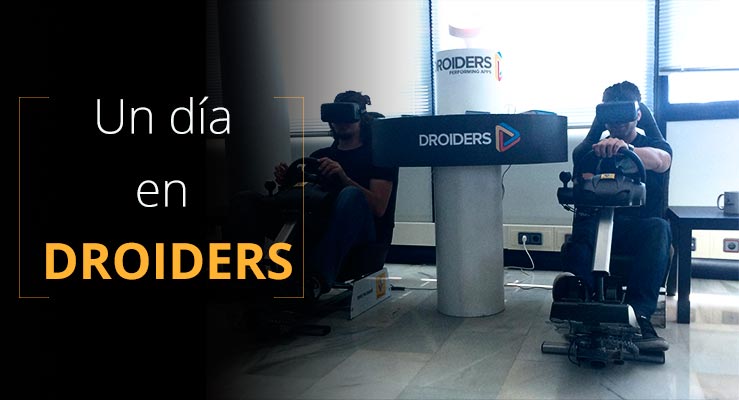
portada Droiders smartglassEstamos en el centro financiero de Murcia, son las 8:30 y Droiders abre sus puertas. El olor a café y el sonido de unas risas es lo único que nuestros sentidos perciben al abrirse las puertas del ascensor. Es entonces cuando al entrar vemos unas enormes Smartglass colgadas del techo. Ya comienza la jornada de trabajo, desayunando con unas espectaculares vistas desde la torre en la que se ubica la principal sede de la empresa.

Torre Droiders smartglass

Sede principal de Droiders

Tras el rápido desayuno en grupo, el equipo de desarrollo atraviesa un pasillo que va al corazón de la empresa. Aquí es donde ingenieros, diseñadores y desarrolladores trabajan con el software y los dispositivos de realidad aumentada como Epson Moverio, realidad virtual y wearables con la tecnología más avanzada.

pizarra smartglass adrian

desarrolladores smartglass moverio

Desarrolladores con Epson Moverio y Google Glass

A las 9:30, después de pasar un tiempo frente al ordenador, el equipo de marketing llega a la sala de juntas. Informa sobre los temas a tratar y el trabajo del día anterior. Se enciende el proyector y desde unas Google Glass, con una lista de tareas de Streye Checkr y vía streaming, se comienzan a pasar diapositivas. Para ello utilizamos Streye Live Pro. Un software para Smartglass diseñado por nosotros mismos. En la presentación se tratan puntos sobre la estrategía y la campaña de un nuevo producto. Después del encuentro el equipo se traslada a su departamento y continua avanzando en el proyecto.

Droiders smartglass expo

Presentación con Google Glass y Streye Live Pro

Es la hora de tomar algo, entre las 11:00 y las 11:30 en la oficina hay un ajetreo generalizado en distintas direcciones. Unos toman el office para preparar unas tostadas mientras otros amenizan su día dejando durante unos instantes el mundo real con unas Oculus Rift. Se sumergen en otro mundo, un mundo virtual. El desafío es una carrera de formula 1 que dirá quién es el más rápido y quién será el encargado de traer la comida hoy.

race droiders smartglass oculus

Inmerso en una carrera virtual

Una visita llega a la oficina, directivos de la empresa y clientes se dirigen a la sala de juntas. El resto va retomando  sus puestos, trabajaremos creando nuevos conceptos y desarrollándolos para traernos el futuro un poco más cerca. La calle está a punto de ser tomada por dispositivos que van más allá de los móviles. Los wearables son prendas de vestir que almacenan, transmiten y reciben información. La hiperconectividad ha llegado para quedarse.

desarrolladora software smartglass

Trabajando en nuevos conceptos

¡La comida está aquí! Avalancha, cola para el microondas, los departamentos quedan vacíos. Las mesas del comedor son ahora las protagonistas. Entre bocado y bocado se escuchan comentarios y risas. Al terminar llega un paquete de mensajería, un compañero lo abre y al puro estilo de Steve Jobs nos presenta un nuevo smartwatch que estaban esperando los desarrolladores.

Son ya las 15:30. En las 2 últimas horas de trabajo el equipo de diseño y de usabilidad web, diseña las páginas y los displays que se usarán en la campaña. El equipo de marketing analiza el rendimiento y los resultados de las estrategias anteriores. Poco antes de la hora de salida es la última reunión, se comentan los resultados y cuál será el trabajo de mañana.

En Droiders la mirada está puesta en lo que existe, pero buscando lo que está por venir. Trabajando aquí te das cuenta de que el futuro no está lejos del presente. Está aquí, en el siguiente minuto y vamos directos a por él.

Droiders ¡Performing Apps!

Una RV verdaderamente “Inmersiva”

Miércoles

29

abr

Era una tórrida y soleada tarde de sábado en algún lugar del sur de Florida. Algunos de los vecinos habían llevado muchos enseres y cosas a sus jardines frente a sus casas para una rutinaria venta de jardín, tan típico de aquellos lares. Pasaba por allí y decidí echar un vistazo. vi un Betamax de los ochentas, un montón de camisetas de John Deere…y algunos libros. ¡Tenía que comprarme una de esas camisetas! La sección de libros no tenía nada interesante que ojear, excepto un libro de primera edición con el que me tropecé:The Second Self: Computers and the Human Spirit (El Segundo Uno Mismo: Los Ordenadores y el Espíritu Humano)

Great book by Sherry Turkle

Great book by Sherry Turkle

Algo salta dentro de uno cuando lee un título así. La autora era la doctora Sherry Turkle, quien hoy en día es Directora de la Iniciativa del Instituto Tecnológico de Massachusetts para la Tecnología y el Ser en el Programa de Ciencia y Tecnología;  compré aquel viejo libro de tapa dura por unos cuantos céntimos y esto fue lo que leí en la Introducción: “La tecnología cataliza cambios no sólo en lo que hacemos sino en cómo pensamos. Ella cambia la consciencia de las personas sobre sí mismas, luego mutuamente y de su relación con el mundo…Ella desafía nuestras nociones no sólo del tiempo y la distancia, sino de la mente”. Esto lo escribió en 1984.

Chateando sobre la ‘inmersión’ y de cómo la Realidad Virtual (RV) zarandea nuestras mentes, es fácil extrapolar sobre cómo puede afectar a la educación. Para quienes consideramos que la educación es la columna vertebral del futuro, la RV is mucho más que un método de escape tal como lo hemos visto en películas de ciencia ficción.Droiders también desarrolla para Oculus Rift para más de un propósito: eso se llama Responsabilidad Social Corporativa.

From Oculus VR

From Oculus VR

Nosotros en Droiders, de la misma manera que Palmer Luckey, fundador de Oculus VR, compartimos esa aventura: hacer resaltar positivamente las capacidades humanas. El artículo en la revista Magazine testifica sobre esta próxima misión, catalizadora e inmersiva, para enriquecer las mentes humanas a través de preguntas inusuales.

De Antiguos y Nuevos Signos: RA, RV y el Núcleo

Miércoles

29

abr

In Hoc Signo Vinces, “Con este signo, vencerás” dice así la traducción al latín del relato de Lucio Lactancio sobre la visión del Emperador Constantino, del Chi Rho (Crismón); nuestro querido emperador no era cristiano en toda regla aunque este evento sí que le dejó una indeleble marca en el alma – y puede que no creas esto – la cual de un plumazo cambió la historia de un continente, y tambien del mundo. Este signo le inspiró para ganar una gran batalla.

Para aquellos que trabajamos – y nos apasiona –  el campo de lo intangible, el cual es, el internet de todo, necesitamos signos para entender y aprender de tales hazañas. Esta es una forma de acercarse a ellos: el Profesor Derrick de Kerckhove de la Universidad de Toronto, filósofo y campeón de los medios emergentes, ofrece tres signos a destacar en su libro “Inteligencias en Conexión: Hacia una Sociedad de la Web”; se les conoce como Interactividad, Hipertextualidad y Conectividad.

Así que, hoy por hoy , ¿Cuáles serían los signos a conquistar? Y en verdad, ¿qué se va a conquistar y en qué batalla?  Ahora esa es una pregunta a meditar todas las noches. Seamos pragmáticos!

Debemos pensar en la Interactividad como el “cuerpo” o vinculación física de las personas; Hipertextualidad, la vinculación de los contenidos o los conocimientos basados ​​en el modelo de la memoria humana; por último, Conectividad – un término tan bienquisto por los seguidores de la Nueva Era – como la vinculación “mental”. La interactividad es táctil; Hipertextualidad, el contenido siempre cambiante y globalizante; La conectividad, el medio (¡Ajá, ahora recuerdas a McLuhan!).

¿Es inevitable augurar que RV y RA sean resultados de estos “signos”? La respuesta es sí. Es inevitable. ¿Cómo lo sé? Bueno, ¿alguna vez te has puesto unas Google Glass? ¿O unas elegantes gafas Epson Moverio? ¿Y qué decir de otros wearables? Todos ellos parecen ser “inteligentes”.

0ca6bc1b4ad26fb43699b57eb1e54a7db468ebeb

Si nos adentramos, encontramos incluso que una persona ciega puede interactuar con su entorno con la novedosa aplicación ReadAloud OCR (Reconocimiento de Caracteres Ópticos) desde unas Google Glass.
Como humanos, estamos logrando extender nuestros sentidos hacia lo invisible (como cualquier místico solía hacer), justo como Constantino lo hizo antes.  Nos hemos hecho más complejos. ¡Viva la complejidad!

Streye, el futuro de tu empresa

Lunes

20

abr

Decía Tom Clancy, que la tecnología es una herramienta que nos ayuda a mejorar nuestras vidas. Por eso queremos anunciar que en los próximos días podréis adquirir por Internet todos los productos Streye. Y para los que aún no sabéis qué son, hacemos una recopilación de lo que hasta ahora os hemos ido contando para que veáis hasta cómo Streye puede mejorar el rendimiento de vuestra empresa .

Empezamos por Streye Box, el futuro de la medicina. Es un sistema streaming capaz de capturar señales de vídeo de prácticamente cualquier fuente, como por ejemplo instrumental médico, véase, endoscopios, máquinas de ultrasonidos, etc… y enviar esa señal de vídeo utilizando un sistema de alta calidad y bajo retardo, para visualizarlo en unas smartglasses. Es decir, Streye Box captura una imagen de una fuente de vídeo y lo muestra en las smartglasses. Las ventajas que este sistema proporciona son múltiples: el confort y descanso que supone para un médico, la optimización de recursos y el beneficio moral de los pacientes son sólo algunas de estas.

Adjusting Google Glass

Continuando con los sistemas de streaming, tenemos Streye Live, sobre la que ya hablamos en otro post¿Qué podemos hacer con Streye Live? Retransmisiones en directo a Youtube; contar lo que vemos a través de las smartglasses. Puedes crear historias o simplemente contar lo que estás haciendo en ese momento y compartirlo en directo a través de la mayor plataforma de vídeo online.

Luego tenemos Streye Live Prouna herramienta de streaming colaborativa que nos permite pasar a otro dispositivo lo que hayamos capturado en nuestras smartglasses, y viceversa. Con Streye Live Pro podemos compartir documentos o archivos multimedia entre ambos dispositivos, y además nos permite ver en el smartphone lo que se ve a través de las smartglasses. Por ejemplo, si has hecho una fotografía con las smartglass, puedes retocarla con tu teléfono sin apartar la vista de las gafas y hacerlo de forma completamente segura.

Finalmente, encontramos Streye Checkr, una aplicación que permite crear listas de tareas y verificación, colaborando en equipo para mejorar la productividad. Podrás adjuntar archivos multimedia y añadir información a una lista de tarea y compartirla para que otros las completen, asegurando el éxito total de cualquier procedimiento y sin perder tiempo, pues de esta forma todos sabrán los pasos a seguir.

Google Glass used during surgery Concentred surgons operating with a touchscreen on a hospital

Streye está pensado para mejorar la eficiencia de cualquier empresa, pues con estas aplicaciones es fácil compartir trabajo, ganar experiencia, pedir una opinión y colaborar en equipo para generar una mayor productividad. No olvides entrar a la página web para tener más información sobre los productos Streye.


Fórum de la Salud

Martes

07

abr

Hoy y mañana (7 y 8 de abril) se celebrará en la Feria Internacional de Lisboa, el foro de innovación en salud a cargo del Ministerio de la Salud de Portugal. Este espacio estará destinado al debate sobre el presente y futuro de la salud, en el que se destacarán temas como las mejoras y avances tecnológicos en salud.

Droiders y Epson serán invitados que se podrán ver en este fórum, hablando principalmente de las Moverio de Epson y su uso en la salud a través de tecnologías como Streye o apps como MedicAR.

epson-moverio-bt200-3

Mañana, 8 de abril, Julián Beltrán, dará una charla sobre el uso de las Epson en los productos Streye, explicando qué es y los diferentes productos que existen, como Streye Live, Box y Checkr. Además, como la charla estará enfocada al sector médico, también se explicarán las ventajas que proporcionan los productos Streye a los médicos y a los pacientes, a nivel económico, moral y de bienestar.

Streye Live permite hacer retransmisiones en vivo a Youtube; Checkr te permite crear listas de procedimientos a seguir, fáciles de seguir y completar; y Box nos permite ver imágenes de un instrumento médico, un endoscopio, en las Smart Glasses y retransmitirlo a una pantalla.

Las posibilidades son infinitas, el cómo seguir mejorando depende sólo de nuestra imaginación.

Guillaume Audy, Author at Droiders

Archivo del Autor: Guillaume Audy

Por primera vez en el mundo, encuadrado en Madrid Fashion Week, se retransmite en directo un desfile a través de Google Glass

Lunes

17

feb

El desfile de la diseñadora española María Lafuente encuadrado en Mercedes Benz Fashion Week Madrid será retransmitido a través del dispositivo Google Glass gracias a la colaboración de Droiders, empresa desarrolladora de aplicaciones y desarrolladores oficiales en Google Glass. La retransmisión en streaming de la colección de otoño/invierno 2014/2015 llamada “Kapok” se podrá seguir a través de www.droiders.com/maria-lafuente.

Además, por primera vez el usuario podrá vivir una experiencia de inmersión única ya que verá la pasarela desde el punto de vista de la modelo, accederá al backstage y podrá vivir en directo todos los detalles antes reservados para unos pocos.

El desfile tendrá lugar el lunes 17 de febrero a las 20h30 en el lugar emblemático madrileño de la Antigua Estación de Atocha y su jardín tropical interior rodeado de árboles y plantas tropicales que harán juego con el nombre de la colección “Kapok”, árbol de fuertes referencias simbólicas que crece en los países tropicales de África, América y Asia.

G’Vine y sus ginebras premium estarán presentes en el cóctel después del desfile y para el cual ha creado en exclusiva el cóctel Kapok inspirado en la filosofía de esta colección que presenta María Lafuente.

D.O.Tierra de León y la Asociación de Sumilleres de León acompañarán el desfile con sus excelentes vinos y caldos y con los jamones ibéricos de la Dehesa de Extremadura cortados por el Embajador Universal de Jamón Ibérico Florencio Sanchidrián.

La colaboración social que caracteriza a la diseñadora se realiza con la ONG Haren Alde, la cual colabora activamente en todo el mundo con programas sociales y que para esta ocasión presenta su campaña con la ablación femenina con la cual María Lafuente se muestra fuertemente comprometida.

Claudia Hierro (hija de Fernando Hierro) participa por primera vez en la Mercedes Benz Fashion Week Madrid de la mano de Maria Lafuente.

Una oportunidad única de disfrutar de la conjugación perfecta entre el arte, la moda y la última tecnología de la mano de María Lafuente y Droiders.

¿Ya te preguntaste cómo fue ser VIP en la última Starlite Gala? Vívelo ahora a través de las Google Glass

Martes

07

ene

En unos meses será celebrada en Marbella la V edición de la benéfica Starlite Gala,una plataforma filantrópica internacional sin ánimo de lucro organizada por Antonio Banderas desde 2010, y este año está llena de novedades.

La edición anterior de la Starlite Gala fue todo un éxito que además contó con la presencia de un invitado especial: las Google Glass de Droiders fueron las protagonistas con las que Antonio grababa, por primera vez en el mundo, una gala benéfica.

¿Ya te preguntaste cómo es ser VIP en la Gala?

Para empezar el 2014 como una celebridad, te traemos en exclusiva el vídeo de lo que allí se grabó entre bambalinas con las Google Glass. Una experiencia única proporcionada por la empresa Droiders, desarrolladores oficiales de Google para Google Glass, con la que puedes acceder al backstage, ver a todas las personalidades en la alfombra roja y tener una visión de la gala desde el punto de vista de los presentadores.

Edición 2014 del Starlite Festival

La edición 2014 del Starlite Festival presentará conciertos como los de Chucho Valdés, Marta Sánchez y Gloria Gaynor, Sergio Dalma, Dani Martín o Julio Iglesias, entre muchos otros. Tendrá como único objetivo el de recaudar financiación que será posteriormente repartida entre fundaciones cuyo fin es el de mejorar la educación, necesidades primarias y la calidad de vida de comunidades, familias y niños sin recursos.

En exclusiva: Apple Glass

Sábado

28

dic

Droiders ha recibido hoy un gran sorpresa.Lo hemos vuelto a hacer, Apple nos ha dejado probar en exclusiva sus Apple Glass!! El equipo entero está impresionado por su diseño definido y elegante, por no mencionar la tecnología de vanguardia presente en el dispositivo.

20131228_100939

2013-12-28 10.00.48

Teniendo en cuenta de que sólo es un prototipo, tiene algunas funcionalidades impresionantes como:

  • Filtro verde permanente para subir fotos a Instagram
  • Luces LED integradas de última generación
  • Varios días de duración de batería
  • Muy poco pesada (20gramos)
  • Precio de venta estimado $69
  • También disponible en rojo y purpura

Sólo nos lo han dejado un par de horas, pero suficiente para desarrollar las primeras apps, os mantendremos informados de los avances.

Performing Apps – We develop Google Glass Glassware for brands

Home

Glassware – Apps for Google Glass™

We’re Glassware Pioneers devising Apps for Google Glass™, the radical new wearable device that is revolutionising the mobile market with incredible potential. We specialise in Glassware for brands, with a proven track record and skillset in streaming, medical, augmented reality, and geolocation apps.

Selected Glassware by Droiders

4

Droiders Chef

8

Banco Sabadell

6

Concierge

Bracelets, heart rate, activity monitors, vests, shoes, smart glasses, watches

Category Archives: Wearables EN

Wearables from bracelets, to heart rate monitors, vests, shoes, smart glasses, watches and all new wave devices of computing that we wear upon us.

Wearables and the implications for brand marketing

Tuesday

04

Feb

Last week, I had the pleasure of joining Max Minzer, a digital marketing and local search consultant and guests; Tim Moore, a Wearable Technologist at VentureGlass, and John Nosta, a Forbes contributor and leading digital health writer on a Hangout.

The topic was wearbles and brand marketing as you can atest below and certainly Google Glass featured most prominently.

Before the video however, allow me to highlight a few charts that serve as food for thought for marketers.

The following chart from Forrester Research (reproduced with permission from Ben Grossman) shows what consumers are expecting from a device like Glass  – which pretty much matches the off the shelf functionality it currently offers.

forrester Google_Glass

This chart using data from Google Trends for USA (blue), Spain (red) and UK (yellow), displays how in the last week alone, search query volumes for Google Glass in Spain, for the first time since last year when Glass was released, eclipsed even that of USA.

EN trends598

Crown Prince Felipe of Spain wearing Google Glass

Crown Prince Felipe of Spain wearing Google Glass – image: EFE Press

The explanation is most likely due to the Google Glass Fitur effect.

Crown prince Philip of Spain wore Glass last week opening Fitur as did other high profile ministers at the tourist trade fair and each time Google Glass makes an event or brand appearance, it is clear the device has immense pulling power.

There is an undeniable interest for Google Glass.

What will that mean for marketers and brand marketing?

Will Glassware (that is apps made for Google Glass) become part of the marketers branding arsenal?

Will consumers expect certain brands to offer Glassware as par for the course, just like today they expect Apps for mobiles?

Will utility and context rule the day and foster brand loyalty if brands oblige without resorting to an interruptive promotional mentality?

Here’s the #maximpact Hangout

Let me know your thoughts in the comments or hit me on twitter or Google Plus.

The terminology of Wearables in spanish – tecnología ponible – and the debate that ensues

Monday

03

Feb

A few years ago blogs were known as bitácoras (in Spanish). Over time, languages evolves. Sometimes we don’t all agree.

Today the Fundeu – La Fundación del Español Urgente – established in 2005 as a non profit institution with the main goal of promoting the proper use of the spanish language in the media, has published a new recomendation:

We’ve seen how lately the terminiology related with this technology has created quite a stir. Last week, even the El País Semanal did not use that term to define it.. The one who decides here is the user:


¿What do you think?

Digital Trends and wearables – the 2014 view from SAScon

Friday

17

Jan

SAScon is an online marketing conference held in Manchester, UK, that unites the agency marketing community to chew the digital fat, debate online modern marketing issues and latest trends.

Given the marmite like reaction to wearables and in particular to Google Glass, I thought it might be interesting to gather a two bit straw poll of marketing community opinion about Glass during Mini SAScon on Friday 17th January to  reflect views from leading agency marketers and online profesionals.

Take a moment and answer these two questions:


I will be taking part in a round table discussion of digital marketing trends for 2014 and look forward to meeting old friends and new faces.

And yes, I will be wearing them, so you’ll recognise me even if you have never seen me before.

A heads up….this post will be updated with video, quotes and more during and after Friday 17th.

To stay informed or be featured here  ping me on Google Plus, or leave a comment below.

Or if you are feeling really uber, answer my question on Jelly.

Jelly, feta cheese and the future of the ephemeral wearable web

Wednesday

15

Jan

When Twitter came to light in 2006, few people took it seriously. Until SXSW of 2007 it didn’t truly enjoy mass use. Furthermore, Biz Stone, the co-founder of the service was told on occasion that twittr, as it was initially known then, was fun but not particularly useful.

Neither is ice cream. So what if it’s just fun? Biz Stone

Well last week, in addition to the blitz of news about wearables from CES 2014, saw the launch of a new service from Biz Stone, called Jelly.

Jelly is an app that defines itself as a new way to search which feeds off your social contacts. It’s a kind of conversational search engine.

Jelly is an app for Android & iOS.

Jelly is an app for iOS & Android.

Although, for now at least, you cannot do a search in the classic sense as we are used to.

You connect to Jelly with Twitter or Facebook with your mobile, you ask a question with a photo and you throw it to the stream.

Point. Shoot. Ask.

Jelly feeds off your pesonal social network although it does not pretend to be a standalone network in itself. Here nobody has a profile and so there is no mad rush to register one and attract followers of sorts.

You can reply to questions with text, with a link and you may also draw an answer with your finger.

I’m not going to dive into detail how the app works, there are already tonnes of posts on tech blogs explaining how to use the service, it’s limitations and it’s potential.

Some compare it to Aardvark, which Google acquired then closed down, with Quora but more visual and quick, with Yahoo Answers but with more credibility, with Google Goggles but more socialble.

The fact is the place is not even a week old and there are already thousands of questions in Jelly about how it should evolve to serve users. Things like hashtags, search functions, tags, if brands should be active and how, and so on.

As always, when early adopters get to grips with a new app or service, the place tends to become saturated with conversation about the service itself in a meta kind of way.

A source of empathy?

Despite the criticsm and comparisons – something that all apps go through at the start – one thing that caught my attention was the statement (expressed in more detail on Techcrunch) from Stone that Jelly aims to generate empathy.

Some have asked why is Jelly would triumph where other Q&A services have not, or what utility does this app have that others do no, or why should we further fragment even more our attention with yet another service or app, when nowadays we have gajillions for every possible scenario.

It’s evident that it is ever more difficult to compete for users’ attention, that there is an avalanche of content and at the same time, there is a boom in sites that aim to serve the ephemeral web – Snapchat, Vine, Tumblr and more – sites that where a delightful user experience with content that is close to your interests and aligned with your social graph, encourage a feeling of empathy and capture precious user attention however fleeting it may be.

Where does Jelly fit in?

If you have used the app or you feel bombarded by questions and all sorts of random encounters, you may be asking yourself the same thing.

And yet, on the official Jelly blog, they explain what is their use case vision of the site. Citing Einstein, Jelly’s goal is that we apply our collective wisdom and experience to help other, over simply spreading information.

Despite that, it appears there are many questions on Jelly that do not necessarily follow the example in the explainer video, where Biz finds himself infront of a work of art in a forest, he takes a pic, and feeds the stream to fathom the mystery of the object.

Questions such as where am I?, who is this? is this person attractive? and such,  that now exist in abundance on Jelly, or those questions that only seem to be designed to generate interaction, are perhaps not the finest use case examples of the platform.

What is clear is that people are experimenting with how to use the platform and checking if it is likely to evolve with any more sophistication.

The Jelly power user

Out of sheer curiosity, Droiders also joined in, popping a question to the flock of early adopters by asking: how many apps do you estimate you have installed on your mobile? just to check if the average for the early Jelly users is significantly different to that average as described below that we also blogged about last week.

68 apps installed for Jelly uses versus an average of 26 for non Jelly users

And despite receiving responses almost immediately, we are aware that, maybe in the longer term, this is not the place to poll user opinion.

By the way, the average number of apps installed by jelly users, in this case was 68 compared to the Statistia 26 of the infographic as published in Mashable as shown above.

What is the meta with feta on Jelly?

For each question posed on Jelly, no matter how serious or flippant, there are all sorts of replies and of course, sarcasm and absurdity are never in short supply.

Maybe the most widely repeated to date is the case of the feta cheese answer that some have dubbed spam in everything but name.

fetacheese

If you have not come across feta cheese whilst using Jelly, perhaps you have been lucky (or not?) or you simply have not swiped away enough questions.

And yet, in the case of the feta cheese replies, there is a more subtle force at work and we can reveal how it really came to be and how the fate of feta has evolved.

Having my mobile in my hand whilst I boiled the kettle for a quick unglamourous yatekomo snack (think freeze dried noodles with a sachet of flavouring) I throw out this question via my personal Jelly account.

Jelly yatekomo

Note: yatekomo (sic) is a fictious mispelling of the phrase in Spanish which roughly translates as – I’m about to eat
you, but as pronounced in spanish it has a fun sort of far east oriental accent sound to it when repeated quickly.

It’s onomatopoeia is, dare I say it, exquisite.

And long behold, in response to my mildly inane Jelly query, I received an answer of feta cheese, which just about qualifies in this context as an accurate answer as it is a word pun on the sound of the word fatter.

OK, not strictly a brand name which I was asking about, but not too bad nonetheless for a fleeting chuckle.

A little later, I noticed that each time I attempted  to answer a Jelly question, the app would struggle to eliminate the previous answer in the cache, and I would inadvertently answer a question with the previous answer to a wholly unrelated question.

The app was buggy and sure enough my Android device duly updated itself with a new iteration of Jelly several times in those first few days of activity.

Maybe the same issue afflicted Lee Stacey who with uncanny coincidence therein after, began answering questions with the same absurd answer of feta cheese.

Pretty soon a deluge of feta cheese answers inundated Jelly to the increasing chagrin and bemusement of fellow users..

And so it continued with no sign of a user  ban in store for Mr Stacey.

To the point that some openly doubted if feta cheese were actually a brand trying to muscle in on the action:

Is feta cheese a brand?

The reality is that in all probability, feta cheese is a mild form of silly protest against those questions that do not meet the expectations of the platform, let alone the standards of Einstein.

Take a look at a tweet of our friend Lee offering a hint of an explanation in a polite exchange of thoughts with another Jelly user:

Maybe we need to look beyond Jelly to really understand Lee’s motives.

That said, if you want a real deep dive of the user behaviour data that Jelly users have left in their wake, take a look at the excellent RJMetrics blog piece.

Absurdity is big business

So if empathy is an brand goal which offers value, companies graft it every day and earn it, not only with high quality production ads, lower budget efforts on YouTube or in tweet exchanges with famous celebrities with powerful followers.

Translation: @raquelsastrecom At long last I feel like a normal woman, I am really excited because tomorrow I am going to try on some new glasses. Google Glass !! @droiders

@raquelsastrecom we will do everything posible to normalise you as you so desire Raquel…”we have the technology” -pg

Translation: Lookout @raquelsastrecom you will have to first pass through the lab before you can leave here wearing Glass.


Huge tech brands that perhaps you do not immediately associate with the absurd, infact devote part of their marketing efforts wholesale into ridiculousness, so they can, according to them, and I quote:

compete with your wife and doughnuts for your attention.”

In this recommended Social Pros podcast, Tim Washer, a consultant for Cisco, explains to Jay Baer of Convince & Convert, how the stateside manufacturer of routers uses humour to connect with their b2b audience to indeed open doors to sizeable sales deals.

And the absurd is not at all reserved to a few daring brands and geeks who use shiny new apps in an unconventional way. Only this week  No Pants Subway Ride was celebrated in cities all around the world including here in Madrid.

So what role do wearables have in all this?

Wearable tech not only allows us to enjoy contextual utility at any given moment but it also enables those moments of total human expression to be seen and shared from the faithful perspective of the wearer, allowing those instants to be captured for posterity.

How many times has that opportunity to seize a photo at a critical moment escaped you, which, even if you had whipped out your mobile quickly, you would simply not have captured it in time?

google-glass child

That photo above was captured with Google Glass. Hands free, in the zone, without a contrived pose or expression in sight.

Wearables allow us that and more. With minimum effort and intrusion we can take a photo and share it, or even ask our network, in a mere few seconds.

And so whilst it remains a tad early to venture the possibility  – as there is no formal Jelly API at the moment – I will end on one final thought or indeed pose the question, naturally, in a picture below, itself worth more than a thousand words.

Jelly #throughglass ?

Wearables and the implications for brand marketing

Wearables and the implications for brand marketing

Tuesday

04

Feb

Last week, I had the pleasure of joining Max Minzer, a digital marketing and local search consultant and guests; Tim Moore, a Wearable Technologist at VentureGlass, and John Nosta, a Forbes contributor and leading digital health writer on a Hangout.

The topic was wearbles and brand marketing as you can atest below and certainly Google Glass featured most prominently.

Before the video however, allow me to highlight a few charts that serve as food for thought for marketers.

The following chart from Forrester Research (reproduced with permission from Ben Grossman) shows what consumers are expecting from a device like Glass  – which pretty much matches the off the shelf functionality it currently offers.

forrester Google_Glass

This chart using data from Google Trends for USA (blue), Spain (red) and UK (yellow), displays how in the last week alone, search query volumes for Google Glass in Spain, for the first time since last year when Glass was released, eclipsed even that of USA.

EN trends598

Crown Prince Felipe of Spain wearing Google Glass

Crown Prince Felipe of Spain wearing Google Glass – image: EFE Press

The explanation is most likely due to the Google Glass Fitur effect.

Crown prince Philip of Spain wore Glass last week opening Fitur as did other high profile ministers at the tourist trade fair and each time Google Glass makes an event or brand appearance, it is clear the device has immense pulling power.

There is an undeniable interest for Google Glass.

What will that mean for marketers and brand marketing?

Will Glassware (that is apps made for Google Glass) become part of the marketers branding arsenal?

Will consumers expect certain brands to offer Glassware as par for the course, just like today they expect Apps for mobiles?

Will utility and context rule the day and foster brand loyalty if brands oblige without resorting to an interruptive promotional mentality?

Here’s the #maximpact Hangout

Let me know your thoughts in the comments or hit me on twitter or Google Plus.

Loading Facebook Comments …

blog – google glass glassware development, wearables, ponibles, android

La primera implantología del mundo para Google Glass: Avinent Glass

Miércoles

09

jul

Avinent Glass es la última aplicación que hemos desarrollado en el dispositivo Glass para la empresa líder en el sector de la odontología, AVINENT.

Consiste en una aplicación de implantología en la que el odontólogo va recibiendo en Glass las instrucciones precisas para realizar el protocolo quirúrgico de colocación de implantes dentales.

Esta nueva herramienta es de gran utilidad para ayudar al profesional de la odontología en su tarea diaria mejorando su seguridad y comodidad, además de asegurar una mayor eficiencia con el paciente.

El pase de diapositivas requiere JavaScript.

El Glassware se compone de una pre-operative Checklist, la cual proporciona al auxiliar clínico una lista de verificación con todo lo que necesita y debe tener en cuenta antes de proceder a la intervención. Por ejemplo: caja quirúrgica, muestra radiográfica del paciente, implante, etc.

La siguiente fase es la identificación del implante marcado con un código QR. Antes de realizar la cirugía, el doctor identifica el implante gracias al dispositivo Glass, reconociendo éste automáticamente las características del implante como el diámetro, la referencia, el lote, etc.

Tras realizar estos pasos, llega el momento de empezar la cirugía. En este punto se hace un seguimiento del protocolo de cirugía, que trata de informar en Glass la acción a realizar y el instrumental necesario en cada momento.

Además, la aplicación permite tomar fotografías durante la intervención, capacitando así al doctor a tener una cirugía documentada y archivada.

A continuación, os dejamos la demostración de esta explicación en un vídeo.


Otra acción en la que la mejora de recursos y ahorro en tiempo suman y dan como resultado la naturalización de la tecnología en nuestro entorno laboral.


El primer Historial Clínico del mundo en Google Glass

Martes

08

jul

Hoy hemos presentado para el Hospital Perpetuo Socorro de Las Palmas de Gran Canaria la primera aplicación del mundo de un Historial Clínico para Google Glass.

La aplicación está totalmente integrada con el sistema de gestión del recinto hospitalario, y hace posible que un médico pueda ver el historial de su paciente en el dispositivo mejorando la calidad asistencial dada la agilidad y exhaustividad que proporciona al pasar consulta.

El pase de diapositivas requiere JavaScript.

Acceder a la aplicación es muy sencillo, escaneando un código QR impreso en una pulsera que lleva el paciente entraremos en la interfaz del Historial del paciente. Ya no hay necesidad de llevar papeles o perder el tiempo consultándolo en el ordenador, de una forma automática y sin perder de vista al paciente mejoraremos la relación médico-paciente.

La información a la que podemos acceder se estructura en seis pestañas:

  1. Los factores de riesgo: tras mostrar la información personal (nombre, edad, fecha de nacimiento, fecha de ingreso y número de paciente) el doctor podrá consultar los factores de riesgo del paciente, por ejemplo, alergias y antecedentes familiares.
  2. La Evolución Médica: se puede leer el tratamiento que se le ha aplicado al paciente y la respuesta que está teniendo al mismo.
  3. La Evolución de enfermería: se comprueba si al paciente se le ha administrado ya la mediación así como los datos básicos relativos a su estado, como por ejemplo: la saturación, la tensión y la temperatura.
  4. Las Pruebas solicitadas: se tiene acceso a todas las pruebas solicitadas por el médico.
  5. Los Tratamientos: indica qué medicamentos se aplican al paciente y cada cuánto tiempo.
  6. Los Documentos: se puede acceder a los resultados de los análisis, el electrocardiograma y todas las pruebas realizadas desde el ingreso del paciente.

Una nueva tecnología se implementa desde hoy en un recinto hospitalario para facilitar el día a día al personal sanitario.

Una acción más en la que Droiders apuesta por la medicina y la tecnología como simbiosis de una nueva revolución profesional y sanitaria.

logo de hospitalperpetuosocorro

Presentamos en canal 24h las funciones de la app para ver RTVE a través de Google Glass

Lunes

30

jun

Sara Navarro del equipo de Droiders, estuvo hace unos días en el canal 24h de RTVE presentando nuestra nueva aplicación, la primera del mundo, que permite ver todos los canales de esta cadena en las Google Glass.

Os dejamos el vídeo del programa con la explicación del funcionamiento del Glassware para TV.

Si tienes Google Glass, puedes cargar el Glassware de RTVE.es

rtve for Glass - Get It On GLASS

Hablamos con Silvia Barba y JJ Santos sobre la Selección y su futuro

Domingo

29

jun

El insustancial España – Australia que ganamos 3-0, no sirvió de bálsamo para nuestras penas. Esa victoria no nos hizo olvidar que momentos después que acabar el encuentro deberíamos coger el avión rumbo a España, para acompañar a una maltrecha Selección que ganó cuando ya no servía.

Con mucha amargura dejamos atrás un país exuberante, en plena expansión económica y con unas gentes que te hacen pasar de la desconfianza al cariño.
cielo2_mini

El regreso

La vuelta a España de la Selección estaba prevista para el día después del partido, pero se adelantó debido a la presión que hicieron los jugadores. Nadie quería alargar más este sufrimiento.

Así nos montamos en el avión a eso de las 18.00 horas locales. Un vuelo de 12 horas con escala técnica en Las Palmas.

Durante el trayecto, después del desayuno y a escasos minutos de aterrizar en Madrid, tuvimos la ocasión de preguntar a dos grandes periodistas del deporte español: Silvia Barba y JJ Santos. Conocidos por sus carreras en TVE y Telecinco respectivamente.

Ellos nos cuentan su valoración sobre la participación de España en el Mundial y como ven a la Selección de cara al futuro.


A perro flaco todo son pulgas

Pero dos últimos lunares iban a empañar la imagen extra deportiva de la Selección. El primer lunar lo puso Jordi Alba (@JordiAlba), lateral izquierdo del FC Barcelona. Al terminar el encuentro contra Australia, en zona mixta, dedicó sin ni siquiera pararse, unas graves amenazas al periodista del Diario AS Javier Matallanas (@Matallanas). Después en el avión, el periodista buscó al jugador para pedirle una explicación, a lo que este despachó con más insultos y desprecios. 

Yo mismo fui testigo de las conversaciones que se suscitaron en el avión entre Matallanas y sus compañeros tratando el tema. Nadie sabía el porque de la reacción del futbolista y las cábalas que se desataron y que pude escuchar, deben quedarse en la intimidad de la conversación que las produjo. En cualquier caso, lo sucedido es un claro síntoma de que en las derrotas cuesta mantener el tipo y siempre hay quien busca trasladar su cólera a los demás.

Y el último lunar lo quiso poner la Selección en bloque. Salieron de Barajas por la puerta de atrás. En furgonetas que los alejaban de los 200 aficionados que tuvieron la buena voluntad de acercarse a la terminal para apoyar a sus ídolos. La frase tan manida de que el “futbolista es egoista”, debe haberse forjado en situaciones como esta. Yo recibí las decepcionadas miradas de los hinchas que nos veían salir a nosotros en lugar de a los jugadores. Fue un momento descorazonante. Personalmente el peor de haber sido eliminados del Mundial. A las personas que fueron a dar las gracias por tantos años de triunfo, se les pagó con el peor de los desprecios: no hacer aprecio.

Y así, deshilachados, con el grupo incompleto (algunos jugadores se quedaron en Brasil),  terminó el Mundial 2014 de Brasil para España.

España cae eliminada en la fase de grupos del Mundial 2014 de Brasil

Sábado

21

jun

España ha sido eliminada del Mundial 2014 de Brasil tras su derrota ante Chile para el pase a los octavos de final. No ha hecho falta ni jugar el tercer partido para decidirlo. Las derrotas cosechadas ante Holanda y Chile nos apean por la vía rápida de la competición. España es, junto con su compañera de grupo Australia, una de las dos primeras selecciones en hacer la maleta y abandorar la competición.

Causas del desmoronamiento del grupo

El segundo partido de la Selección se tornó en una final tras la debacle ante Holanda . Sin embargo, no parece que los jugadores del combinado nacional tuvieran la entereza necesarea para afrontarla. O quien sabe si nunca pensaron en este partido como una final y tuvieron en sus mentes la derrota como una posibilidad. Una temporada larga, en donde la mayoría de los jugadores ha llegado hasta el mes de Mayo disputando títulos con sus clubes, puede ser una de las causas por las que este grupo no ha estado a la altura en una cita de máximo nivel como esta, que no permite fallos ni entrar al campo con tibieza, dudas o reservando esfuerzos. Podemos apuntar miles de causas de este fracaso. Pero es insólito que una selección que quedó primera en su grupo de clasificación para el Mundial, que no perdió ningún partido y que solo encajó tres goles, haya caido fulminada a las primeras de cambio.

Por eso nadie se pone de acuerdo en las causas por las que España ha perdido sus dos partidos, ha encajado siete goles y tan sólo ha marcado un tanto de penalti. Si un servidor tuviera que apuntar alguna me decantaría por el plano mental. Vi jugadores superados ante Holanda y nerviosos antes Chile. No creo que sea un selección vieja. Sino más bien que no supieron reaccionar en el primer partido y que después nunca creyeron que pudieran remontar esa situación.

Maracanã

El histórico y más legendario de los estadios de fútbol del mundo es donde España hincó la rodilla sin paliativos. Un estadio reservado sólo para grandes gestas donde no supimos plantar cara al rival. Remodelado para la ocasión, está a la altura para acoger la final del 13 de Julio. El acceso al campo por parte de los aficionados no fue todo lo ideal que podría ser y se organizaron grandes colas para entrar. Yo mismo tarde más de media hora en llegar a mi asiento desde que llegué a las inmediaciones del estadio.

Acceso Maracana

Del total de 78.838 localidades se ocuparon 74.101 para este partido. La diferencia tuvo que darse en otra parte del campo, porque desde donde yo estaba no vi un asiento vacío.

Marcana capacidad

El partido en la grada

Esta partido lo perdimos también. La ciudad de Río de Janeiro fue tomada por más de 60.000 chilenos un par de días antes del partido. De ellos aproximadamente 50.000 tenían entrada,  por sólo unos 2.000 españoles. Tras la goleada encajada por España en el primer partido, los chilenos acudieron llenos de entusiasmo sobre la victoria de su equipo. Un pueblo que estaba enfervorecido por verse superiores en número y adivinarse ganadores de la contienda por la debilidad mostrada por España. Tal era la locura de los chilenos que un grupo de unos noventa aficionados entraron por la fuerza y llegaron hasta la sala de prensa, donde fueron reducidos y posteriormente deportados. Ya en la grada, el grito que más se escuchó fue el de: “Chi-chi-chi-le-le-le…..VIVA CHILEEE!!!!”. Este cántico se repitió en Maracaná continuamente sin que los españoles pudieran hacer nada para contrarrestarlo. Con los ánimos ibéricos por los suelos después del segundo gol se comenzó a oir el: “eliminaaados, eliminaaados”. Debido al resultado y al tremendo ambiente, muchos españoles abandonaron la grada antes del final del encuentro.  Así quedó patetente una vez más que la derrota no tiene amigos y que el éxito no tiene memoria.

España Chile Mundial 2014

Las consecuencias

Una de las consecuencias más claras de este fracaso es la más que probable retirada de la Roja de pesos pesados como Xabi Alonso, Xavi Hernández, Villa y Casillas.

Incluso la del seleccionador Vicente del Bosque que ha dejado abierto su futuro y ya tiene a gran parte de la prensa en contra.

El final de una aventura

Y con este amargo sabor de boca me despido de esta competición. Ya poco importa el tercer partido ante Australia. Ha sido un placer poder haber vivido esta experiencia de la mano de Droiders y haberla compartido con vosotros en este espacio. He conocido cantidad personas, he vivido infinidad de momentos y me vuelvo para España deseando poder volver a vivir una experiencia como esta algún día.

Alejandro Loza

Obrigado!!

La Coronación de Felipe VI con RTVE Glass app #throughGlass

Miércoles

18

jun

Desde Droiders lanzamos en primicia mundial la aplicación para ver la Televisión en Google Glass desarrollada para el grupo de RTVE.

Desde ahora podremos ver la televisión en este nuevo dispositivo y todos los que tengan la suerte de disponer de las Gafas inteligentes de Google podrán ser partícipes de La proclamación de Felipe VI a través de TVE en la aplicación rtve for Glass.

Copyright ABC

Copyright ABC

En la aplicación se distinguen cuatro canales pertenecientes al grupo: La 1, La 2, TDP y el Canal 24 horas y todos conectarán en directo para retransmitir este punto tan importante en la historia de nuestro país.

Una iniciativa pionera por parte nuestra y de RTVE nos abre paso a una nueva forma de comunicar y consumir medios. La tecnología vestible o wearable technology es el siguiente paso en la adaptación de la tecnología a nuestro entorno y gracias a ella ahora podremos consumir el medio más tradicional a través del canal más innovador.

RTVE se convierte así en la primera plataforma de medios multi-dispositivo. Ahora sí es una realidad poder ver la televisión a través de cualquier dispositivo y llegar así a todo tipo de público y lugar.

¿Quieres descargarte el Glassware de RTVE.es?

Si tienes Google Glass, puedes cargar el Glassware de RTVE.es

rtve for Glass - Get It On GLASS

Droiders desarrolla la primera aplicación en el mundo para ver la televisión en Google Glass con RTVE #throughGlass

Miércoles

18

jun

Droiders ha desarrollado la primera aplicación para ver la Televisión en el mundo a través de Google Glass para el grupo RTVE.

logo RTVEes

Gracias a la apuesta tecnológica de TVE y la confianza depositada en Droiders para la creación de esta aplicación, hemos conseguido marcar historia en el mundo de la tecnología. Por primera vez en la industria de los medios somos capaces de ofrecer contenido multi-dispositivo: desde la televisión tradicional, pasando por tu ordenador, el smartphone, la tableta y ahora, la Google Glass.

El video demuestra el contenido que se puede acceder desde hoy #throughglass


La tecnología vestible o wearable technology ha venido para crear una revolución en la sociedad al implementarse de una manera natural en nuestro día a día. Las gafas inteligentes de Google son sólo el primer paso.

Podrás estar en el tren de viaje o subido a un avión, ponerte tus gafas y poder ver cualquiera de los canales de tve: La 1, La 2, TDP y el Canal 24 horas en cualquier momento del día.

Su uso es muy sencillo: sólo tendrás que entrar en la aplicación, seleccionar el canal que quieres ver y darle al play. Así de simple y eficaz

¿Quieres descargarte el Glassware de RTVE.es?

Si tienes Google Glass, puedes cargar el Glassware de RTVE.es

rtve for Glass - Get It On GLASS

Asistimos al descorazonante estreno de la Selección española en el Mundial Brasil 2014

Domingo

15

jun

Salvador de Bahía. Una ciudad al noroeste de Brasil con casi cuatro millones de habitantes, fue testigo del descalabro de la Selección española en el comienzo de este Mundial. Apodada como  la “Capital de la Alegría”, se tornó en “martes de carnaval” para el combinado de Don Vicente del Bosque.

Droiders Google Glass Mundial Brasil 2014

Y la verdad que nada ni nadie parecía advertir lo que iba a pasar. El ambiente tanto entre los aficionados como entre la prensa deportiva, era de que íbamos a empezar este torneo con una victoria sobre Holanda. Todos estaban de acuerdo en que esta Holanda era más débil que la que ya vencimos hace cuatro años. Nada más lejos de la realidad o de lo que fue a suceder sobre el terreno de juego.

El estadio de “Arena Fonte Nova“, propiedad del Gobierno brasileño y remodelado para esta Copa del Mundo, fue donde casi 50.000 espectadores vieron caer a la vigente Campeona del Mundo por 1 – 5. España recibió en un solo partido más goles que en las dos últimas competiciones que ganó de forma consecutiva: Mundial 2010 y Eurocopa 2012. Esto da una idea del tremendo varapalo sufrido por este equipo en el día de ayer.


El ambiente en el estadio

En el estadio podía haber un 60% de aficionados holandeses frente a un 40% de aficionados españoles. Los holandeses además estaban más concentrados en ciertas zonas del campo. Unido esto a que la afición local apoyaba incondicionalmente a Holanda, hizo que el partido en la grada estuviera perdido desde el minuto uno.

Pero eso no era todo. Un ambiente hostil contra Diego Costa se fraguó desde el inicio del partido. Cada vez que la pelota llegaba a las inmediaciones del jugador de Lagarto nacionalizado español, un tremendo abucheo atronaba todo el estadio. Después, ese abucheo se transformó en canticos sobre el jugador. Para dejar una idea del ambiente que se vivió contra Diego Costa, decir que incluso un cuarto de hora después de su sustitución seguían produciéndose cánticos en contra de el.

Esto evidencia y deja bien a las claras que los brasileños están dolidos por su nacionalización. Y que por supuesto temen al que sobre el papel puede ser el jugador más temible de la Roja, con 36 tantos en la temporada 2013-2014 a sus espaldas.

Holanda pasó por encima a España

Y fue de esas cosas que hacen que el fútbol sea un deporte impredecible. En la primera parte España mantuvo el tipo, desplegando su juego habitual y mandando en muchas fases del encuentro. Hasta llegó a ponerse por delante en el marcador con un penalti más que dudoso que transformó Xavi Alonso en el minuto 26 del encuentro. Incluso tuvo la oportunidad de sentenciar el marcador en las botas de David Silva, que a pase maravilloso de Iniesta, probó suerte con una vaselina que el portero adivinó y atajó.

Sólo un minuto después, y al filo del descanso, Van Persie, con un acrobático remate de cabeza puso tablas en el marcador. A partir de entonces, en la segunda parte sólo hubo un equipo sobre el campo. Fallos en bloque de toda la defensa española pusieron en bandeja de plata la goleada de Holanda.

Los aficionados Holandeses

Conscientes de lo que acababan de conseguir, el equipo holandes dió una vuelta de honor al campo al acabar el encuentro saludando a todos los hinchas que se agolpaban en las primeras filas de la grada. Esto insufló todavía más orgullo a la afición holandesa, que no dudaban en dirigirse a nosotros para mostrarnos su felicidad. Pero todo transcurrió con mucho respeto por ambas partes como podemos ver en la imagen.

España Holanda Mundial Brasil 2014

La marea roja

La marea roja abandonó el estadio cabizbaja y haciendo cábalas sobre los resultados que tenían que darse para nuestra clasificación. Por si fuera poco Chile comenzó ganando a Australia y acabó goleándola. Lo que hundió todavía más el ánimo de la hinchada española, ya que ese resultado nos pone las cosas muy difíciles en caso de triple empate.

Y en estas se puso a llover torrencialmente sobre los ya maltrechos corazones españoles. Una noche para olvidar pronto y que tiene remedio ante Chile el próximo miércoles 18 a las 21.00 horas, horario de España. #LetsGoFootball

Entrevistamos a Javier Herráez y Raul Gamonal de la prensa Deportiva Española

Viernes

13

jun

En el vuelo que compartimos con el equipo nacional y la prensa que sigue a La Roja desde Washington hacia Curitiba, el pasado 8 de Junio, tuvimos la inmensa fortuna de poder charlar con dos grandes espadas de la prensa deportiva nacional: Raúl Gamonal (Mediaset) y Javier Herráez (Cadena Ser).
javi raul-lgf
Aprovechamos el vuelo para obtener información de primera mano de las sensaciones que ambos periodistas tienen sobre selección horas antes de su estreno mundialista contra la subcampeona del mundo, Holanda.

Primero charlamos con Raúl Gamonal, conocido por sus apariciones televisivas en los canales de Mediaset. El es uno de los miembros más destacados del operativo de más de 60 profesionales que Mediaset ha enviado a todo Brasil para cubrir el Mundial 2014.

Transcripción entrevista a Raúl Gamonal #throughglass

Debido a la acústica del video en el avión, os dejamos aquí una transcripción de la conversación mantenida.

AL- Estamos con Raúl Gamonal en el viaje hacia Brasil con la Selección española y vamos a aprovechar para hacerle unas cuestiones. ¿Qué sensaciones te deja esta fase de preparación?

RG- Para mi he visto a los jugadores mejor de lo que esperaba, después de una temporada larga siempre esperas que algunos jugadores estén digamos entre algodones, mal físicamente… Pero los he visto bastante bien en general a casi todos. O sea que yo me llevo una sensación positiva. Luego al equipo lo veo otra vez con ganas de ganar, eso es siempre importante.

AL- ¿Y a los que venían un poco tocados crees que están ya todos al 100%? ¿O hay alguno que necesite algún día más como se dice de Costa? Que aunque hizo un buen partido ante la selección del Salvador parece que no dio esos sprints que el acostumbra a hacer. 

RG- A Costa le falta sobre todo minutos. No tener miedo a lesionarse otra vez, perder ese miedo. Hacer entrenamientos seguidos para volver a ser el antiguo Costa del Atlético de Madrid, lo que le falta es más entrenamiento más preparación física, porque le veo un poquito justito. Date cuenta que en los dos últimos meses ha tenido tres lesiones y ha podido entrenar muy poquito. Y otro que veo un poco tocado es a Juanfran. A ese le veo un poquito más tocado.

AL- ¿Del tobillo? El lo niega constantemente y dice que está bien…

RG- Viéndole correr el partido de ayer eh… parece que no está en condiciones, que le cuesta, no está fino. No le veo…

AL- Y luego escuché también que la prensa comentaba el bajo estado de forma, no ya de lesión, de Jordi Alba

RG- Jordi Alba lleva sin jugar desde el 2 de Abril, creo recordar, o el 16 de Abril… Eso es mucho tiempo sin jugar. Son más de dos meses y medio sin jugar. Le faltan partidos. Y es un chaval que se basa mucho en su físico, con lo cual es importante que recupere ese fondo físico, esa forma física. Creo que lo va a recuperar partido a partido. Va a ir de menos a más y creo que va a ser titular y que va a ser el gran Jordi Alba de por ejemplo la Eurocopa.

AL- De los amistosos que hemos jugado ¿Se puede extraer alguna conclusión? ¿O debido al bajo nivel de las selecciones es mejor no….?

RG- Lo dicho por Del Bosque, más que resolver dudas repartir minutos entre todos los jugadores. Creo que Vicente sabe como va a jugar España, tiene varias formas de jugar y España es un equipo con una base de digamos 14, 16 jugadores y puede jugar cualquiera. Con lo cual, como tiene esas dudas resueltas, aprovechó estos dos amistosos para repartir minutos, simplemente para eso. 

AL- Y hablando un poquito de esto, de la forma de juego de la Selección española, no ya la alineación, pero ¿Qué esquema crees que va a sacar del Bosque contra Holanda? ¿Vamos a jugar por las bandas, vamos a jugar con falso nueve? 

RG- El partido de Italia de la inauguración de la Eurocopa, va a ser ese calco, ese planteamiento. Con Cesc Fabregas de falso nueve y luego pues los cuatro atrás, los cuatro en el medio campo y Cesc Fabregas de falso nueve. Entrando mucho por las bandas con Silva o por la otra banda Iniesta.

AL- Y ya por último ¿te arriesgas con algún resultado?

RG- ¿Para Holanda o para el Mundial? AL- Para Holanda

RG- ¿Para Holanda? Ganamos seguro. Holanda no es la Holanda de hace dos años y a parte tiene muchos jugadores lesionados claves. Creo que España mucho mejor ahora mismo que Holanda. Con lo cual debe y va a ganar

AL- De acuerdo Raúl, pues muchísimas gracias! RG.- A ti! ¡CLACK!

Javier Herráez Cadena Ser Hablando de las perspectivas de la Selección Espanola de Fútbol

Después charlamos con Javier Herráez. Desde el verano de 2010 en la Cadena Ser y siempre al tanto de las noticias del Real Madrid.


Transcripción entrevista a Javier Herráez #throughglass

Debido a la acústica del video en el avión, os dejamos aquí una transcripción de la conversación mantenida.

AL- Estamos con Javier Herráez, periodista de la Ser, casi 30 años de experiencia en la profesión le contemplan…

JH- Un poco menos….

AL- ¿28 puede ser? JH- No me acuerdo ya pero 26, 27 por ahí….

AL- Vamos en el vuelo de Iberia, de la Selección, volamos junto con el equipo nacional, camino a Brasil, a Curitiba nuestra sede y tenemos la suerte de poder hablar un poquito con el. ¿Qué sensaciones te ha dejado esta fase de clasificación?

JH- Bueno pues, lo esperado o mejorado. Pensaba que había futbolistas que llegaban un poquito más justos, el caso de Piqué, el caso de Busquets… Pero yo creo que han trabajado bien, han hecho una minipretemporada para el Mundial. Costa no se ha resentido y yo creo que además el equipo une a un futbolista muy importante tanto fuera como dentro del terreno de juego como es David Villa, que ayer marca dos goles ante el Salvador en un partido intrascendente y amistoso pero que siempre viene bien para reafirmar a un futbolista que dentro de ese grupo tiene mucha trascendencia. Creo que es positivo que David Villa haya marcado dos goles.

AL- Sí, yo también. Y había muchas dudas sobre su convocatoria ¿no? O sea que esos dos goles zanjan lo que podían decir que no estaba haciendo goles en el final de temporada, que sólo luchaba.

JH- Sí. Es una realidad. Si miras lo que hizo en el último Mundial, hoy en el avión hemos podido ver lo que hizo en Sudáfrica….. Porque pasan las cosas, las ves en directo y luego hasta que no recapitulas y pasa un poco eso, el tiempo, para poder lo que hizo, te das cuenta la exageración, la bestialidad que hizo David Villa en ese Mundial con golazos contra Honduras, contra Chile en la primera fase, el que marcó ante Portugal y el que marcó ante Paraguay. Al final fue una burrada y es verdad que David Villa ha perdido ese punto de llegar antes que el defensa, pero trabaja, es listo, es un hombre que sabe lo que tiene que hacer y eso es para mi un activo más de la Selección.

AL- Sí, es un viejo rockero y nos viene bien que el haya cogido confianza y que haya marcado esos dos goles. Una de las cosas que también te quería comentar que ya la has adelantado un poquito era como ves que han evolucionado todos los tocados de la Selección, que parece que todos llegan al 100%, por lo menos de salud.

JH- Bueno, 100% no están. Se vio ayer a Costa y lo reconoció ayer en la zona mixta, que no se pegó tres carreras de las suyas, hizo algún sprint, pero bueno, disparó con la izquierda….hizo cositas pero no es el Costa, para mi el Costa que queremos todos creo que tienen que pasar diez días. Tampoco estará ante Holanda, yo creo que ante Chile podría ya empezar a estar

AL- ¿Piensas que no va a ser titular ante Holanda? JH- Yo creo que no. Pero lo creo, esto lo sabe Del Bosque, Miñano y Ochotorena. Me parece bien, o sea ni los jugadores hasta dos horas antes del partido nadie lo sabe. Eso me parece que activa al grupo.

AL- Esa es la mecánica de Del Bosque, siempre dos horas antes del  partido.

JH- Si, no lo sabe nadie. Salvo que lo quiera hacer para activar a algún jugador, alguien que no está jugando habitualmente…. y hay muchas formas de activar a un futbolista, se le puede dar mensajes para que el capte que puede ser un hombre que vaya a jugar, para que este más no se si más activo pero si más despierto, porque sabe que tiene ante si una ocasión. Pero no suele hablar mucho con los futbolistas Del Bosque porque dice que cuando hablas mucho te puedes equivocar o la gente puede malinterpretar y eso creo que es bueno. Ese contacto, ese saber estar con los deportistas y a la vez no darlo todo.

AL- Si, que algún jugador se sienta decepcionado porque pueda haber entendido que Vicente en algún momento le había dicho que iba a jugar o que contaba con el…

JH- Tu puedes pensar que un futbolista está bien para jugar dentro de cuatro días y en los siguientes entrenamientos baja el pistón y a lo mejor te gustaría cargártelo pero le has dicho ya que va a jugar… Es mejor esperar a última hora, decides y si tienes que hacer algún retoque lo haces sobre la marcha.

AL- Entonces, teniendo en cuenta esta posible no baja, sino no alineación de Diego Costa ¿Cuál crees que podría ser el esquema? No ya la alineación, sino el esquema con el que jugaría Del Bosque, falso nueve, no falso nueve, con extremos, sin extremos…

JH- Fíjate, yo pensaba que iba a ser un falso nueve claro pero ayer por ejemplo Cesc estuvo un poquito más flojo. Yo creo que tampoco el partido de ayer va a servir para que quite a un futbolista y ponga a otro. Pero si que es verdad que Torres está bien y que podría meter un delantero, o porque no a Villa que metió dos goles, aunque yo le veo más como segundas partes a Villa, no creo que lo ponga. Mi idea, creo que va a jugar muy junto la Selección, mucha asociación, ayer ensayó el pase largo con Xabi Alonso y Diego Costa… Pero yo creo que ver a Busquets con David Silva, Andrés Iniesta, Cesc Fabregas, a Koke y a Pedro por banda puede ser una alineación.

AL- ¿Tu metes a Koke en la alineación titular? JH- Desde luego está muy bien

AL- Si pero parece ser que tendría que ocupar el puesto de Xavi…

JH- Ese es el dilema.

AL- Parece ser que sería muy bruto a lo mejor, que no se atrevería o que no sería correcto todavía meterlo en el partido inagural o en el primer partido contra Holanda… Sino dejarle el primer partido a Xavi y después sacar alineaciones con respecto a los estados de forma.

JH- El que piense que a Del Bosque  le tiembla el pulso o que no toma decisiones y cree que los que estaban antes o que han estado durante mucho tiempo en la selección son intocables no le conoce. Porque el creo que obra con justicia y se puede equivocar como nos equivocamos todos, pero no es un hombre que no actúe con su justicia o con su idea de lo que tiene que poner en el terreno de juego. Xavi no es un jugador más, Xavi ha sido y es todo para la Selección española. Prescindir de Xavi Hernández es casi prescindir de la Selección española… No olvidemos que lleva un mal año y que para titular a lo mejor no está. Yo creo que no es fácil, creo que no es una decisión fácil porque además como tu dices es el primer partido y…. sino juega el primer partido a lo mejor puede jugar el segundo o ya es que es suplente o juega el primero y juega todos… Mira lo que hizo en la Eurocopa, parecía que no iba y luego fue el mejor en la final.

AL- Si, eso es cierto, eso es verdad. Y ya la última pregunta. ¿A que jugadores son a los que ves más en forma ahora mismo?

JH- David Silva, Azpilicueta, Sergio Ramos, veo bien a Torres, Andrés Iniesta… para mi son los que mejor veo. AL- Hay media docena de jugadores, ves a la Selección muy enchufada por lo que veo.

JH- Si. Esos seis los veo súper. Yo creo que vamos a ver la mejor versión de Silva, a la mejor versión de Ramos, a la mejor versión de Busquets, la mejor versión de Iniesta…

AL- ¿Y la mejor versión de Casillas?

JH- Muy buena versión, no se si la mejor porque también junto con Iniesta o con Villa, pero bien, ha hecho un buen año y creo que el fallo de la final pero creo que no hay problema.

AL- Vale, pues nada Javier por último ya final ¿Un pronóstico para el partido, te arriesgas?

JH- Si! Yo creo que va a ganar España. AL- De acuerdo, pues muchísimas gracias.

JH- A ti.

AL- Ciao, hasta luego. ¡CLACK!  

¿Quieres más opinión y contenido #LetsGoFootball con más reporteros de la Selección?

Tenemos otra entrevista en exclusiva throughglass con Juanma Castano tipo #LetsGoFootball.

Manolo el del Bombo #throughglass

Domingo

08

jun

Todo el mundo en España conoce a Manolo el del bombo. Pero cuando estás a 6.000 kms de la piel de toro y todo el mundo busca una foto con el más famoso hincha de la Selección española, es cuando verdaderamente puedes ser consciente de su calado.


Manuel Cáceres Artesero, más conocido como “Manolo el del bombo”, lleva 40 años “animando” a la Selección, como el mismo dice. En estos años ha logrado ser el hincha más reconocible de la escuadra nacional, y los últimos éxitos de la selección han catapultado su popularidad.

Fuimos testigos del fervor que levanta a su paso, en este caso en Washington DC. #throughglass #LetsGoFootball.

Mobile, Wearable apps, Google Glass apps development, Android, iOS

servicesBanner

Services

Glassware – Apps for Google Glass

We develop Glassware – that’s Apps made explicitly for Google Glass.

We’re experienced with Google’s Developer APIs, Glass design guidelines, XE software updates, developer and community innovations and the Android ecosystem, to devise and deliver Performing Apps on Glass for the next wave of wearable tech.

Banc Sabadell

In October 2013, we built the world’s first retail banking app for Banco Sabadell.

elmundo-glass1

El Mundo

We made the first newspaper Glassware in Europe for a highly respected title in August 2013.

ReadAloud OCR

In June 2013, we unveiled ReadAloud OCR, on the Spanish TV program El Hormiguero for the visually impaired.

Streaming Through Glass

Google Glass offers unprecedented Point Of View photography and filming experience for an unrivalled intimate view.

Combined with custom Glassware features, the use case options are extensive.

Droiders technology offers streaming through Glass and has conducted several high profile streaming projects with mhealth professionals, politicians, presenters and other hosts worldwide.

Pedro Guillen

Dr. Guillén

Dr. Pedro Guillén became the first surgeon in the world to webcast an operation through Google Glass with Droiders in June 2013.

Prime Minister Rajoy

Prime Minister Rajoy

The Spanish Prime Minister wore Glass at the Partido Popular’s conference in spring 2014 which included streaming from the conference floor.

Hospital CUF Infante Santo

Hospital CUF Infante Santo

Doctors from Portugal conducted multi camera operations through Glass, of 3 hours duration, including POV through Google Glass, streamed by Droiders.

Events with Google Glass

We can elevate your event to the next level with exclusive Glassware to transform the experience of guests and presenters alike.

Google Glass attracts huge traditional and social media interest to any premier professional organised event.

Droiders has a track record of devising and pairing event Glassware for prestigious occasions in Spain and Europe.

Madrid Fashion Week

Google Glass has made appearances during Madrid Fashion Week in 2014 and on Cibeles on several occasions thanks to Droiders. During the Mercedes Benz-Fashion Week in 2014, Google Glass was worn during the show with live streaming by catwalk models to showcase the 2014-2015 autumn/winter Kapok collection. In the photo,  L’Oréal Paris official blogger and model, Mayte de la Iglesia reports from L’Oréal fashion week with Google Glass.

Renault Techno Experience

Renault Techno Experience

In march 2014, Renault held roadshows in Madrid, Barcelona and Bilbao, showcasing a new range of vehicles bristling with cutting edge technology. Test drive guests enjoyed the exclusive opportunity to view augmented reality playback of Renault Techno Experience videos through Google Glass, when sat behind the wheel. The specially made Glassware invoked video playback by viewing physical targets affixed to the vehicles dashboard.

Starlite Gala Marbella

The annual Starlite Gala, attracts a host of high profile public figures from film, fashion, TV to raise funds for charitable causes. At the head of proceedings Antonio Banderas, wore Google Glass to stream the charity auction from the podium. The inclusion of Google Glass in the summer of 2013 for Starlite Gala secured significant added media attention for the event and was a contributing factor to raising funds totalling €267,860 for causes such as Lagrimas y Favores.

Android and iOS Development

Need Android and iOS mobile app development? – We’ve been building apps for years on both platforms.

We’re delivered dozens of successful mobile Apps on Android and iOS for clients and agencies since 2008 and continue to do so.

Pioneering Surgery for Medical Education Through Google Glass Next Tuesday

Pioneering Surgery for Medical Education Through Google Glass Next Tuesday

Wednesday

14

Aug

Droiders works once again with Dr. Pedro Guillén and the Cemtro Clinic on a pioneer surgery project through Google Glass, in collaboration with Google and Telefónica. The Google Glass event is an interactive master class where, for the first time in History, Google Glass will be used for tele-education, with active participation from its audience.

Hospitals and universities will be able to learn, for the first time, two pioneer techniques through Glass, watching the first person perspective of Dr. Guillén while he is performing them. The surgery procedures are autologous chondrocyte implant and wireless arthroscopy . They will be streamed via Google Glass thanks to Glassters Streamer, the streaming system for Google Glass developed by Droiders.

Dr. Guillén will offer this class live to 300 hospitals and universities around the world with the active participation from the audience. Two prestigious surgeons from EEUU and Europe will connect with him live through Google Hangouts to offer their input and comment during the surgery´s development. To participate as medical professionals or students in this event, please contact the Cemtro Clinic www.clinicacemtro.com. Thanks to Telefónica, the 300 terminals from these hospitals and universities will be able to receive the video signal in HD, with three different screens showing three video transmissions: the one from Google Glass, one from inside the knee recorded with the wireless arthroscopy, and another recording a different perspective of this surgery.

To everyone else interested, this event will be streamed here, on the Droiders website, live this Tuesday from 4:00 to 6:00 p.m. (CEST). .

Dr. Guillén performing a surgery with our Google Glass.

Dr. Guillén performing a surgery with our Google Glass.

Here´s the press release about this event in English:
Press release Google Glass Master Class Sept 17th

Loading Facebook Comments …

Multi Google Glass Interview with Juanma Castaño #LetsGoFootball

Multi Google Glass Interview with Juanma Castaño #LetsGoFootball

Friday

06

Jun

Last monday on the official flight with the Spanish National Football Team from Spain to Baltimore, USA, we held a friendly interview with the journalist Juanma Castaño weighing up the chances of la Roja for the World Cup.

And why not, we both conducted the interview #throughglass.


Of course, it will not be the first time we talk pure football over the next few weeks.

If you want to get on aboard with us, stay tuned to the hashtag #LetsGoFootball y #LaSeleccionPorDentro both on Google+ as in Twitter and via the Twitter account of our Droiders embedded Glass Explorer Reporter, Alejandro Loza @alesonline.

Transcription multi Glass de #letsgofootball nº1

Due to the noise levels on the plane, we will leave you with a transcription of the conversation.

AL – ¿Do you feel the players are tensed up, that they are stiff, which is what you just said, that all that pressure is on their shoulders and it seems you meant to say that it wouldn’t be a failure to not win this World Cup, do you sense that?

JC – No, I think they are still in the mode of how their team season has been, it’s been really tough for all involved, and I suppose that from now they will get in the World Cup groove, but I don’t think the pressure affects them that much as they come from big clubs, they are very used to that, I think in that respect they are well rehearsed to it.

AL – Alright, and the last one, what is your precidction for the group stage, as we’ve got the group of death?

JC – Well, everyone says that the danger is Chile, so I’ll go along, that the danger is Chile, I don’t know, in my mind we are better than Holland that’s for sure…

AL – Have you thought anything of Van Gaal, some tactic, something that they’ll do just against us?

JC – Holland is, based on what we’ve seen, far worse than the Holland of the last World Cup final, and Spain isn’t not much worse than that World Cup Final. Chile is an unknown, and Australia is well inferior, I think that in the group stages, we shouldn’t have any problems, in theory, but it’s very importatnt to start off well, eh.

AL – Do you think the team that yields a point to Australia will be the one of three that get’s left behind?

JC – That’s a possiblity, but I trust that we win the first game against Holland because that will inevitably give you…

AL – Will set the cast…

JC – Yeah, to win the first game gives you…a real boost

AL – OK, then top of the group..

JC – For sure, if only..

AL – Alright then

JC – Cheers.

¡WHACK!

Loading Facebook Comments …

Google Glass and tourism at FITUR 2014 with Droiders

Google Glass and tourism at FITUR 2014 with Droiders

Wednesday

29

Jan

Last week, during 2014 FITUR (Feria Internacional de Turismo en España), Droiders presented new technologies in the field of tourism to improve hotel user experiences. Google Glass really stole the show in terms of the attention garnered. Below are a selection of articles that featured Droiders and Google Glass.

Loading Facebook Comments …

Jelly, feta cheese and the future of the ephemeral wearable web

Jelly, feta cheese and the future of the ephemeral wearable web

Wednesday

15

Jan

When Twitter came to light in 2006, few people took it seriously. Until SXSW of 2007 it didn’t truly enjoy mass use. Furthermore, Biz Stone, the co-founder of the service was told on occasion that twittr, as it was initially known then, was fun but not particularly useful.

Neither is ice cream. So what if it’s just fun? Biz Stone

Well last week, in addition to the blitz of news about wearables from CES 2014, saw the launch of a new service from Biz Stone, called Jelly.

Jelly is an app that defines itself as a new way to search which feeds off your social contacts. It’s a kind of conversational search engine.

Jelly is an app for Android & iOS.

Jelly is an app for iOS & Android.

Although, for now at least, you cannot do a search in the classic sense as we are used to.

You connect to Jelly with Twitter or Facebook with your mobile, you ask a question with a photo and you throw it to the stream.

Point. Shoot. Ask.

Jelly feeds off your pesonal social network although it does not pretend to be a standalone network in itself. Here nobody has a profile and so there is no mad rush to register one and attract followers of sorts.

You can reply to questions with text, with a link and you may also draw an answer with your finger.

I’m not going to dive into detail how the app works, there are already tonnes of posts on tech blogs explaining how to use the service, it’s limitations and it’s potential.

Some compare it to Aardvark, which Google acquired then closed down, with Quora but more visual and quick, with Yahoo Answers but with more credibility, with Google Goggles but more socialble.

The fact is the place is not even a week old and there are already thousands of questions in Jelly about how it should evolve to serve users. Things like hashtags, search functions, tags, if brands should be active and how, and so on.

As always, when early adopters get to grips with a new app or service, the place tends to become saturated with conversation about the service itself in a meta kind of way.

A source of empathy?

Despite the criticsm and comparisons – something that all apps go through at the start – one thing that caught my attention was the statement (expressed in more detail on Techcrunch) from Stone that Jelly aims to generate empathy.

Some have asked why is Jelly would triumph where other Q&A services have not, or what utility does this app have that others do no, or why should we further fragment even more our attention with yet another service or app, when nowadays we have gajillions for every possible scenario.

It’s evident that it is ever more difficult to compete for users’ attention, that there is an avalanche of content and at the same time, there is a boom in sites that aim to serve the ephemeral web – Snapchat, Vine, Tumblr and more – sites that where a delightful user experience with content that is close to your interests and aligned with your social graph, encourage a feeling of empathy and capture precious user attention however fleeting it may be.

Where does Jelly fit in?

If you have used the app or you feel bombarded by questions and all sorts of random encounters, you may be asking yourself the same thing.

And yet, on the official Jelly blog, they explain what is their use case vision of the site. Citing Einstein, Jelly’s goal is that we apply our collective wisdom and experience to help other, over simply spreading information.

Despite that, it appears there are many questions on Jelly that do not necessarily follow the example in the explainer video, where Biz finds himself infront of a work of art in a forest, he takes a pic, and feeds the stream to fathom the mystery of the object.

Questions such as where am I?, who is this? is this person attractive? and such,  that now exist in abundance on Jelly, or those questions that only seem to be designed to generate interaction, are perhaps not the finest use case examples of the platform.

What is clear is that people are experimenting with how to use the platform and checking if it is likely to evolve with any more sophistication.

The Jelly power user

Out of sheer curiosity, Droiders also joined in, popping a question to the flock of early adopters by asking: how many apps do you estimate you have installed on your mobile? just to check if the average for the early Jelly users is significantly different to that average as described below that we also blogged about last week.

68 apps installed for Jelly uses versus an average of 26 for non Jelly users

And despite receiving responses almost immediately, we are aware that, maybe in the longer term, this is not the place to poll user opinion.

By the way, the average number of apps installed by jelly users, in this case was 68 compared to the Statistia 26 of the infographic as published in Mashable as shown above.

What is the meta with feta on Jelly?

For each question posed on Jelly, no matter how serious or flippant, there are all sorts of replies and of course, sarcasm and absurdity are never in short supply.

Maybe the most widely repeated to date is the case of the feta cheese answer that some have dubbed spam in everything but name.

fetacheese

If you have not come across feta cheese whilst using Jelly, perhaps you have been lucky (or not?) or you simply have not swiped away enough questions.

And yet, in the case of the feta cheese replies, there is a more subtle force at work and we can reveal how it really came to be and how the fate of feta has evolved.

Having my mobile in my hand whilst I boiled the kettle for a quick unglamourous yatekomo snack (think freeze dried noodles with a sachet of flavouring) I throw out this question via my personal Jelly account.

Jelly yatekomo

Note: yatekomo (sic) is a fictious mispelling of the phrase in Spanish which roughly translates as – I’m about to eat
you, but as pronounced in spanish it has a fun sort of far east oriental accent sound to it when repeated quickly.

It’s onomatopoeia is, dare I say it, exquisite.

And long behold, in response to my mildly inane Jelly query, I received an answer of feta cheese, which just about qualifies in this context as an accurate answer as it is a word pun on the sound of the word fatter.

OK, not strictly a brand name which I was asking about, but not too bad nonetheless for a fleeting chuckle.

A little later, I noticed that each time I attempted  to answer a Jelly question, the app would struggle to eliminate the previous answer in the cache, and I would inadvertently answer a question with the previous answer to a wholly unrelated question.

The app was buggy and sure enough my Android device duly updated itself with a new iteration of Jelly several times in those first few days of activity.

Maybe the same issue afflicted Lee Stacey who with uncanny coincidence therein after, began answering questions with the same absurd answer of feta cheese.

Pretty soon a deluge of feta cheese answers inundated Jelly to the increasing chagrin and bemusement of fellow users..

And so it continued with no sign of a user  ban in store for Mr Stacey.

To the point that some openly doubted if feta cheese were actually a brand trying to muscle in on the action:

Is feta cheese a brand?

The reality is that in all probability, feta cheese is a mild form of silly protest against those questions that do not meet the expectations of the platform, let alone the standards of Einstein.

Take a look at a tweet of our friend Lee offering a hint of an explanation in a polite exchange of thoughts with another Jelly user:

Maybe we need to look beyond Jelly to really understand Lee’s motives.

That said, if you want a real deep dive of the user behaviour data that Jelly users have left in their wake, take a look at the excellent RJMetrics blog piece.

Absurdity is big business

So if empathy is an brand goal which offers value, companies graft it every day and earn it, not only with high quality production ads, lower budget efforts on YouTube or in tweet exchanges with famous celebrities with powerful followers.

Translation: @raquelsastrecom At long last I feel like a normal woman, I am really excited because tomorrow I am going to try on some new glasses. Google Glass !! @droiders

@raquelsastrecom we will do everything posible to normalise you as you so desire Raquel…”we have the technology” -pg

Translation: Lookout @raquelsastrecom you will have to first pass through the lab before you can leave here wearing Glass.


Huge tech brands that perhaps you do not immediately associate with the absurd, infact devote part of their marketing efforts wholesale into ridiculousness, so they can, according to them, and I quote:

compete with your wife and doughnuts for your attention.”

In this recommended Social Pros podcast, Tim Washer, a consultant for Cisco, explains to Jay Baer of Convince & Convert, how the stateside manufacturer of routers uses humour to connect with their b2b audience to indeed open doors to sizeable sales deals.

And the absurd is not at all reserved to a few daring brands and geeks who use shiny new apps in an unconventional way. Only this week  No Pants Subway Ride was celebrated in cities all around the world including here in Madrid.

So what role do wearables have in all this?

Wearable tech not only allows us to enjoy contextual utility at any given moment but it also enables those moments of total human expression to be seen and shared from the faithful perspective of the wearer, allowing those instants to be captured for posterity.

How many times has that opportunity to seize a photo at a critical moment escaped you, which, even if you had whipped out your mobile quickly, you would simply not have captured it in time?

google-glass child

That photo above was captured with Google Glass. Hands free, in the zone, without a contrived pose or expression in sight.

Wearables allow us that and more. With minimum effort and intrusion we can take a photo and share it, or even ask our network, in a mere few seconds.

And so whilst it remains a tad early to venture the possibility  – as there is no formal Jelly API at the moment – I will end on one final thought or indeed pose the question, naturally, in a picture below, itself worth more than a thousand words.

Jelly #throughglass ?

Loading Facebook Comments …

A New Kind of "Glasses" for Ophthalmology

A New Kind of “Glasses” for Ophthalmology

Monday

29

Jul

Last Saturday Droiders had the chance to study with Dr. M.G. Marcos possible Google Glass applications for Ophthalmology, at the Marcos Ocular Institute, in Málaga, Spain.

Doctor Marcos studies Google Glass´ medical applications

Doctor Marcos studies Google Glass´ medical applications

This institution has been the first ophthalmology centre in the world to see the advantages that Google Glass offers in this field. Thanks to Droiders, Dr. Marcos could experience first hand the advances that this device will bring in the upcoming months.

Multiple uses in surgery for Google Glass.

Multiple uses in Surgery for Google Glass.

According to the doctor, Google Glass will be very useful for telesurgery, telemedicine, medical divulgation, facial recognition, etc. In this sense, he points out the cases of laser surgery for short-sightedness, or long-sightedness patients. Google Glass allows in real time to divulge and share the operation. The surgeon is able to consult the patient´s medical files, can ask for advice from any doctor who is connected to his feed, and can search for data on the Internet, all in real time while operating. Dr. Marcos was impressed to see that the viewfinder doesn´t interfere with his field of vision, and hopes to use the glasses in his future operations. Very soon, Doctor!

 Doctor Marcos wears Droiders´ Google Glass

Doctor Marcos wears Droiders´ Google Glass

Loading Facebook Comments …

Pilot School Adventia, first in the world to fly with Google Glass

Pilot School Adventia, first in the world to fly with Google Glass

Monday

10

Mar

Adventia, European Collage of Aeronautics this morning has become the first airline company to carry out a flight with Google Glass, and also the first school in the world to use this type of device in pilot training.

This demonstration has taken place as part of the Pilot Innovation Day and the first conference on “Innovation in the Cockpit”, organized by Adventia, Participating Centre of the University of Salamanca at the Aeronautical Campus at Matacán, Salamanca, Spain.

With the aim of improving flight instruction and training the best pilots, Adventia, along with Droiders, official Google developer, have created a Checklist Glassware (an application for Google Glass) for pilot use.

Viewing on a mobile device, cannot see it? Try this photogallery version.
For more information, please visit www.firstgoogleglassflight.com

Press Release

Loading Facebook Comments …

A First In Fashion History : A Runway Show Broadcasted Live Through Glass As Part Of Madrid Fashion Week 2014

A First In Fashion History : A Runway Show Broadcasted Live Through Glass As Part Of Madrid Fashion Week 2014

Thursday

06

Mar

El desfile de la diseñadora española María Lafuente encuadrado en Mercedes Benz Fashion Week Madrid será retransmitido a través del dispositivo Google Glass gracias a la colaboración de Droiders, empresa desarrolladora de aplicaciones y desarrolladores oficiales en Google Glass. La retransmisión en streaming de la colección de otoño/invierno 2014/2015 llamada “Kapok” se podrá seguir a través de www.droiders.com/maria-lafuente.

Además, por primera vez el usuario podrá vivir una experiencia de inmersión única ya que verá la pasarela desde el punto de vista de la modelo, accederá al backstage y podrá vivir en directo todos los detalles antes reservados para unos pocos.

El desfile tendrá lugar el lunes 17 de febrero a las 20h30 en el lugar emblemático madrileño de la Antigua Estación de Atocha y su jardín tropical interior rodeado de árboles y plantas tropicales que harán juego con el nombre de la colección “Kapok”, árbol de fuertes referencias simbólicas que crece en los países tropicales de África, América y Asia.

G’Vine y sus ginebras premium estarán presentes en el cóctel después del desfile y para el cual ha creado en exclusiva el cóctel Kapok inspirado en la filosofía de esta colección que presenta María Lafuente.

D.O.Tierra de León y la Asociación de Sumilleres de León acompañarán el desfile con sus excelentes vinos y caldos y con los jamones ibéricos de la Dehesa de Extremadura cortados por el Embajador Universal de Jamón Ibérico Florencio Sanchidrián.

La colaboración social que caracteriza a la diseñadora se realiza con la ONG Haren Alde, la cual colabora activamente en todo el mundo con programas sociales y que para esta ocasión presenta su campaña con la ablación femenina con la cual María Lafuente se muestra fuertemente comprometida.

Claudia Hierro (hija de Fernando Hierro) participa por primera vez en la Mercedes Benz Fashion Week Madrid de la mano de Maria Lafuente.

Una oportunidad única de disfrutar de la conjugación perfecta entre el arte, la moda y la última tecnología de la mano de María Lafuente y Droiders.

Loading Facebook Comments …

Droiders en colaboración con la Comunidad Valenciana presenta en FITUR las últimas innovaciones tecnológicas adaptadas al sector turístico y hostelero

Droiders en colaboración con la Comunidad Valenciana presenta en FITUR las últimas innovaciones tecnológicas adaptadas al sector turístico y hostelero

Monday

20

Jan

if_048445

  • Julián Beltrán, CEO de Droiders, dará una conferencia titulada Google Glass: la revolución del turismo, sobre el nuevo dispositivo de Google.
  • Los asistentes tendrán la posibilidad de probar el innovador dispositivo de Google Glass y conocer todas sus funcionalidades.

Desde el 22 hasta el 26 de enero estaremos presentes en FITUR presentando todas las funcionalidades de las nuevas tecnologías en el sector turístico y hostelero, especialmente, las aplicaciones creadas para Google Glass que mejorarán enormemente nuestra experiencia turística.

Además, Julián Beltrán, CEO de Droiders, dará una conferencia el día 24 a las 13:00 horas en el pabellón 10B03  titulada Google Glass: la revolución del turismo, sobre los cambios que el turismo vivirá en el futuro gracias al uso de este dispositivo, y enmarcada en el programa de FITURTECH.

Presentaremos además, en exclusiva, algunas de nuestras aplicaciones especialmente preparadas para llevar el turismo a un nivel superior, lo que es conocido como Turismo 3.0. Domótica y realidad aumentada, entre muchos otros, son algunos de los campos en los que hemos desarrollado aplicaciones cada vez más innovadoras que cambiarán completamente nuestra forma de viajar y de percibir el mundo.

Por último, Droiders ofrecerá al público en primicia la oportunidad de poder probar las Google Glass, conocer todas sus características y utilizar todas sus aplicaciones. Una oportunidad única ya que este dispositivo todavía no ha sido puesto a la venta y Droiders es la primera empresa española dedicada a su desarrollo.

Loading Facebook Comments …

Announcements and opinion from team Droiders

Category Archives: Droiders EN

Announcements and opinion from team Droiders.

Vaso – for optimists/pessimists everywhere

Tuesday

01

Apr

Life is full of uncertainties.

The ever debated question of which came first: the chicken or the egg, proof of primordial gravitational waves, 42, and other cosmogenic theories.

Then there’s the glass of water, filled halfway: Is it half empty or half full?

Developing Performing Apps at Droiders is more than a daily exercise of contemplating such profound philosophical matters.

Vaso – more than code

That’s why we’re proud to announce our latest app, Vaso, a practical solution for Voyagers – as Vaso users are known – in need of defining the status quo.

Vaso accurately measures the volume of liquid contained in a glass and returns a percentage fill readout in a gauge display #throughglass.

Vaso unequivocally answers one of life’s most frequently asked questions that has long since puzzled mankind.


Vaso – serving dual audiences

Feedback from Vaso beta testing sessions has proved crucial for iteration of the app.

The production release of Vaso incorporates that feedback and therefore caters for two distinct audiences.

A Droiders spokesman explains:

Vaso version 0.5 – at the time it was codenamed ‘half’ – proved to be divisive in testing, as about 50 per cent of our control group commented that the gauge label readings were consistently inaccurate.

.. it wasn’t so much the calibrated unit centilitres measurement – which was exhaustively verified – but the terminology of the label that the vasoware displayed of ‘full’ which produced all sorts of disputes among the group of early Voyagers.

Solving the outlook for Vaso

Designers from Droiders adroitly addressed the issue by introducing a ‘settings’ menu allowing the Voyager to configure either pessimist or optimist mode.

This switch ingeniously inverted the scale of the gauge and simultaneously swapped the text labels of ‘empty’ and ‘full’.

This satisfied both sets of Voyagers whilst maintaining the overall accuracy and integrity of Vaso.

Vaso philosophy

Therein lies the beauty of this vasoware because Vaso is much more than just an innovative way of understanding the fill level of a glass of liquid.

How you set up Vaso is a statement of your outlook on life.

This slideshow requires JavaScript.


This is vasoware. And for pessimist and optimist Voyagers everywhere, it’s a symbol of individuality and a belief in personal freedom.

Vaso logic

Vaso is another world first for the team at Droiders based in Europe.

Vaso achieves a high degree of accuracy due to Advanced Processing Realtime Infrared Logic, as devised by Droiders Labs.

The Vaso 50% challenge

So how does Vaso function when faced with a glass with a 50% fill level?

To satisfy both pessimists and optimists, Vaso currently returns a ‘half’ reading, irrespective of the user’s setting.

Crowdsourcing the conundrum

Developers at Droiders remain keen however to tap the wisdom of the crowds to answer the universal conundrum:

Vaso – a clear future ahead

There are compelling opportunities for vasoware deployed in the industrial sector, with the prospect of large scale, hands free, liquid volume inspections.

A retailer version for hospitality business owners to calculate serving yields of alcoholic stock is also being evaluated for commercial demand.

Market research however is strongly suggesting that a consumer vasoware may prove most popular among value for money minded patrons verifying levels of their tantalisingly served beverages.

Mark Anderson of the Windmill Pub

Can I have a top up? – © Mirror

Indeed advanced vasoware could hail the end of disagreements between bar staff and patrons regarding filled levels of served drinks or satisfy trading standards officers who currently can only act at thresholds south of 95%.

Wine glass fills and beer foam complexity

The performance of Vaso with a glass of water is relatively straight forward compared to the challenges of wine, which is typically not served to the brim.

This poses a problem for Vaso interpretating wine fill level deficiencies outside of the lab where beverage conditions are highly varied.

The Piaget Beer Gauge

Piaget Beer Gauge – analogue predecessor to Vaso © Chris Holloway

Beer also has a fiendish trait, frequently presenting foam ratio detection issues, renowned for disrupting the “empty” and “full” scores which can lead to volatile readouts.

“Beer is notoriously tricky… “, states a Droiders spokesperson, and the phenomenon of under serving is indeed a serious matter.

Past efforts to combat tavern injustice include the Piaget Beer Gauge, from the federal research physicist Chris Holloway, whose analgoue invention deploys a mathematical formula in the form of a card to save punters thousands of otherwise lost sips every year.

thebeergauge.com formula - the analogue predecessor of Vaso

For the new era of wearable tech however, Droiders trust that with the release of Vaso today, Voyagers everywhere, pessimists and optimists, will be willing to reach out to us to gather big liquid data, and solve these matters by field testing Vaso in bars everywhere.

FAQ

Is Vaso waterproof?

Yes.

Who is Piaget?

Originally a malacologist, Jean Piaget was a Swiss development psychologist and philosopher who studied humans’ inability to distinguish identical volumes in different sized containers.

When will Vaso being available in Spain?

We expect Vaso to be released in Spain just before the end of the year.

What does Vaso really mean?

Why not search for Vaso, or allow us to look it up for you?

Can I ask you a technical question about Vaso?

No, that’s enough questions. Move along now.

ok glass, undoom

Friday

03

Jan

¡Stop Press! Glass is doomed.

Doomed Crystal Skull Shotglass - pic discovered courtesy of Chris Messina - the hashtag dude - item available on Amazon

“Google Glass is doomed.” In 2014…says the headline.

So, they say, or so they say, they will say.

Well I’ve done the maths.

Er…fuzzy maths, based on the tweet reaction to Robert Scoble’s widely reported latest comments about Google Glass for 2014.

Actually, this is a little more than a quick snapshot from Topsy, comparing the mentions of Doomed versus Doomed 2014, and the ratio of the former to the latter, is about 2.9, so roughly speaking, two in three mentions of the blog post are misquoting Scoble.

Glass doomed in 2014?

And of course, if you believe what you read, Google Glass is doomed.

As Robert himself wryly admits in his opening paragraph, he loves a headline like anybody else. And so indeed do headline writers, much to the chagrin of a source or a PR team.

If you can’t filter the signal from the noise, then Scobleizer’s doom quote therefore becomes a little warped and he’s no doubt used to that and thrives on the debate – he admits as such in the comments on @andrewgrill’s post  which deals with the influencer aspects of cognoscenti and evangelism marketing.

I disagree this is about an influencer management issue. Cat herding is notoriously tricky and some companies do not truly go there.

So how could someone who taunted us so convincingly that he would never remove Glass, even for an infamous near selfie in the shower, could now go so cold on Glass?

Allow me to offer a different photo please.

Bluto - not doomed

‘Over? Did you say ‘over’?

The doomed reality scenario is infact more nuanced with Glass and if you read beyond the headline, or the retweets and if you observe over time, you may reach a more balanced conclusion.

I suspect this public display of a quasi trough of disillusionment, is more than, just that, and whilst Andrew Grill makes some interesting observations about the influencer management aspects of it, the tech press reaction to Glass has been decidely mixed throughout 2013.

It’s plain to see that pundits and press are not always on the same wavelength.

Despite, Martin’s measured take on it, evidently the sparring goes back some way.

Heck, you only need to read as far as the second paragraph in TNW article to realise that when Scoble says it’s doomed, it’s because the tech press tells him so. Infact Scoble has gone on the record to express what he considers Google Glass as a success and despite the misgivings it’s obvious he maintains a belief in the promise of the device: Read Quote of Robert Scoble’s answer to Technology Trends: Will Google Glass Succeed? on Quora

With the possibility of a wearable device from Apple emerging this year, it’s clear that the subject of wearables will make acres of tech column inches – with inevitable comparisons between devices from tech giants – there are already plenty of Glass alternatives from crowd funded devices to lesser known brands, and yet the b2b market for wearable may not be with us for a while yet.

Indeed other commentators don’t expect the wearable curve to really hockeystick for a while yet.

Business Insider – Google Glass Sales Projections

The Droiders team have been privileged to develop Glassware and proper meddle with device since Q2, 2013 and continue to sense a rabid enthusiasm for Glass from the general public, tech professionals and clients alike.

If we’d believed everything we read, we might have thought that Augmented Reality was not possible with Google Glass, when infact, it was back in August.

Had we not pursued the limits of Glass in early summer 2013, we may not have enjoyed watching a blind person use Glass to read signs on prime time TV or enabled pioneering surgeons to operate wearing Glass.

And while both of these Glassware deployments are nascent, like other Glass developers, we’re developing them to meet client demand in 2014.

Is Glass perfect yet?

Nope, of course not. It’s in beta so to speak. A prototype. With less of a distribution than other infamous Google betas (Gmail was 5 five years in beta), it is constantly being iterated on.

Like other developers, we have provided feedback through official channels to Google and it’s clear the product has a way to go to satisfy all demands. But let’s not forget the software at XE12, has on average been iterated each month and huge strides are being made, especially as the recent GDK allows development access to native sensors of the device.

Only this week, the device became more available to new users as Glass distribution steadily increases with the invitation to purchase Glass for Google Play Music All Access users.

Does the Glass criticism stand up?

Whilst we’re not here to dissect each line of Robert’s post, some things do stand out that are worth a rebuttal.

Where’s the Foursquare app? – Dennis Crowley has already said on the record, that Foursquare will not be available on Glass. Yet. He’s also said about a year ago in Barcelona’s MWC: “Anywhere there’s a screen, we want to put our stuff on it, whether that’s on a phone, or a watch, or whatever.”

Battery life – Granted the battery life is not comparable to a smartphone – and nor would anyone reasonably expect it to be. There are third parties toying with extra battery pack add ons, and you can charge the device on the go if you want with a portable battery as many do.

Not enough apps. UX cannot handle lots of apps – Fair point. If you’re an appovore that is and want to install three hundred apps. Not everyone packs in hundreds of apps to their smartphones. Regular users infact only install about 26. But we get your point, the UX is not perfected for app selection from masses of Glassware. Yet.

26 apps average install

And yes, the official distribution for Apps, excuse me, Glassware, is still in it’s infancy, with only some thirty or so official top flight big brand Glassware available in the boutique store of google.com/myglass whilst the others, that we estimate from the likes of unofficial Glass directories like, Glass Apps, to number in the hundred or so, are only available as sideloaded APK files.

The development of the store and inclusion of more high quality apps will only increase as developers iterate their Glassware. But be aware, many are devising Glassware for b2b and niche usage, and not necessarily chasing a b2c elusive glory of a consumer app to compete with Angry Birds™.

Photo workflow sucks – Well, kinda. I thought that at first, but then again, you do reset your expectations and behaviour with Glass. No, you don’t enjoy full media editing within Glass. But after a trip with them on, and taking a succession of photos and videos, I was unexpectedly offered by Google, a neat little video and photo montage set to music of the whole experience.

So it was through the Google Plus account that this happened with the auto-awesome (love the effect, not the vernacular) film offered to me. The joy and convenience of that nullifies the expectation limitation we can inadvertently set ourselves for Glass. It’s a companion device at the end of the day.

No contextual filtering. Google Glass desperately needs those contextual signals to know when to show you appropriate stuff  – Some of this is already handled with the ever learning Google Now and more of it is possible with highly refined Glassware. Context aware Glassware is a win win for everyone and we agree it’s only the start.

As to if Glass will be a success by 2020, that date is seems an eternity away in tech terms and I think comparisons with the Apple Newton and how long that took, before, it morphed to the iPad and achieved phenomenal success are bordering on the pessimistic.

I asked a couple of leading Glassware developers their opinions of the state of Glass going into 2014.

google-glass-cecilia2rCecilia Abadie of Byte an Atom in San Diego ,known as the developer behind Genie App for Glass, co-founder of LynxFit and also the recipient of the now infamous fine whilst driving with Glass, and more recently on the cover of a Yahoo story about Glass in 2014 had this to say:

For us as a startup trying to help people on their path to health and fitness, Google Glass is the best device today and looking forward into the launch on 2014. There is no other sensor loaded hands free device that can bring workouts to people’s lives in a seamless way, using natural interfaces such as voice and touch and liberating our users from ipads and cellphones that completely disrupt their flow.

Adoption is obviously unpredictable and very arguable at this early point, but from our perspective at Byte an Atom Research, we’re betting strongly on wearables and specifically on Google Glass. We also are big believers on Glass for vertical markets and we believe although it’s early for the ecosystem to be mature it’s getting there. We need to take into consideration that the GDK was launched very recently and that will unleash developers potential.

Noble AckersonNoble Ackerson, also of Byte an Atom, the developer behind the Glassware lynxfit.com which is a fitness app for Glass, comments:

I think it’s bordering on pre-mature at this point to count Glass out as gloom. With that said, I am waiting for Google to provide a distribution channel for my app as well so I agree with the distro point.

So is it doomed? In 2014?

Ultimately the omission of the date of 2014 to this Glass story, can as with any date sensitive remark, massively alter interpretations.

Ask any media pro and they’ll tell you. Even hardened media campaigners on the receiving end of a journalistic probe, like the disgraced rider Lance Armstrong fell prey to it.

This summer just gone, only days before the centenary Tour de France,  he declared to french journalists, that it was impossible to win the Tour [during the period 1999-2005] without drugs, and of course that date part was conveniently omitted or misreported for all manner of mayhem to then be unleashed.

But I digress, the nub of the argument here is that the other wearable elephant in the room that has yet to reveal it’s stripes.

And given this is the Age of Context, I don’t regard this outburst as an outright dismissal of Google Glass, nor is it a public blogger relations breakdown.

Apple will invariably make waves when it shows its hand with a retail distribution advantage and latent goodwill awaiting it’s any new product launch, and herein lies the issue, that metaphorical apples and pear wearables will be compared. Unfairly perhaps.

So does that mean Glass is doomed?

I don’t think so.

Do you?

Exclusive: Apple Glass

Saturday

28

Dec

Droiders got a big surprise in the mail today! Apple sent us in exclusivity a prototype of their upcoming Apple Glass. The whole team fell for their sleek and edgy design, not mentionning the state of the art technology beyond the device. Even though it’s only a prototype, it already features a bunch of brilliant caracteristics such as:

  • Permanent green photo filter
  • Integrated flashing lights
  • Several-days battery life
  • Extremely light
  • Suggested retail price of 69$
  • Also available in red and purple

We only had it in our hands a few hours, but we’re already working on developping some innovative applications. We’ll make sure to keep you posted with the results.

Welcome!

Tuesday

16

Jul

Welcome to Droiders World!

Today our blog is born, another way to share with you who love everything app related as much as we do. Droiders has news coming fast and frequently, and we want to tell you first hand about them.
droidersTeam
But we won´t talk just about what´s cooking here. We are fans of everything that is coming up in the app world for mobile devices and webs. Android, Apple IOS, Windows Phone, HTML5, Blackberry OS… we work for them, follow all their latest news and talk about them at the office. And now also with you!

Upcoming and popular apps, the latest gadgets, rankings, interviews, tutorials, programming, design, events… A world of posts. Droiders World.

Droiders develops the first application in the world to view television on Google Glass for RTVE (Radio Televisión Española) #throughglass – Droiders

Droiders develops the first application in the world to view television on Google Glass for RTVE (Radio Televisión Española) #throughglass

Wednesday

18

Jun

Droiders has developed the first application in the world to view Television through on Google Glass for RTVE (Radio Televisión Española) #throughglass.

logo RTVEes

Thanks to TVE hedging their technological bets and placing their faith in Droiders to produce this application, we have reached a technological milestone. As a first for the media industry we are able to offer multi device content: from traditional television, to computer, to smartphone, to tablets and now on Google Glass.

This video shows the content available as of today #throughglass

Wearable technology is upon us producing a revolutionary effect in society by manifesting itself in our daily lives. The smartglasses from Google are just a first step.

You could be on a train or a plane journey, pop on your Glass and watch from any of the TVE channels: La 1, La 2, TDP and Canal 24 horas at any time of the day.

It’s very easy to use: you only have to load up the application, select the channel you want to view and click play. Simple as pie.

Do you want to load the RTVE.es Glassware?

If you have Google Glass, you can load up the RTVE.es Glassware

rtve for Glass - Get It On GLASS

Loading Facebook Comments …

App Developer news and opinion of stories and blog opinion from Droiders

Category Archives: Development

Concentrating on Development of Apps, news and opinion of developer stories and blog opinion from Droiders.

Hangman: Winning Project Of The First Google Glass Hackathon In Spain

Monday

23

Dec

Last weekend in Murcia the first Google Glass hackathon took place in Spain. The event was held by Droiders, an official Google Glass developer and one of the first companies to work with the Glass technology in the world, and hosted in collaboration with GDG Murcia and YouandCo.

The event gathered around twenty developers, all working for the first time with the Google Glass. In the end, José Banet Vincente, Daniel Marin Sánchez y Adrián Javaloy Bornás won the contest with their project called Hangman, a Glass adaptation of the famous game of the same name.


Through the entire event, the participants worked doggedly to find the most creative application for Google Glass. In the end, all applications were submitted and judged by a jury formed by Droiders’ Glass developing team. “All of the projects were really interesting and very well done, especially considering it was the participants’ first time working with Glass” comments Julián Beltrán, CEO of Droiders.

The winning team developed the game Hangman on Google Glass which comprises guessing the letters of a word before the hangman is fully drawn. The three winners were all from the region of Murcia. Each one received a seven inch tablet for winning the first prize.

Digital Trends and wearables – the 2014 view from SAScon

Digital Trends and wearables – the 2014 view from SAScon

Friday

17

Jan

SAScon is an online marketing conference held in Manchester, UK, that unites the agency marketing community to chew the digital fat, debate online modern marketing issues and latest trends.

Given the marmite like reaction to wearables and in particular to Google Glass, I thought it might be interesting to gather a two bit straw poll of marketing community opinion about Glass during Mini SAScon on Friday 17th January to  reflect views from leading agency marketers and online profesionals.

Take a moment and answer these two questions:


I will be taking part in a round table discussion of digital marketing trends for 2014 and look forward to meeting old friends and new faces.

And yes, I will be wearing them, so you’ll recognise me even if you have never seen me before.

A heads up….this post will be updated with video, quotes and more during and after Friday 17th.

To stay informed or be featured here  ping me on Google Plus, or leave a comment below.

Or if you are feeling really uber, answer my question on Jelly.

Loading Facebook Comments …

Droiders accompany the Spanish Football squad during the tournament in Brazil

Droiders accompany the Spanish Football squad during the tournament in Brazil

Friday

30

May

We have some big news to reveal and an adventure to share.

Droiders, pioneer in the development of software for Google Glass, known as Glassware, will attend the forthcoming World Cup held in Brasil.

Our journey starts with a friendly in Seville, 30th May, then onwards to Washington for another friendly and hope the journey ends on 13th July with a second world title for our national squad.

At the same time SeFutbol will bring the event that much closer to the fans with Google Glass. The content captured through Glass will be published on the Google+ page of the national team.

© Copyright RFEF

© Copyright RFEF

The day to day life of the World Cup champion squad will be documented during the most important football event on the planet ever witnessed.

World Cup tournament Calendar with Droiders

In addition we have a calendar of actions lined up with Google Glass full of surprises that we will reveal on this blog giving you the full inside story.

Furthermore we will support the hashtag #LaSeleccionPorDentro, so fans can have the opportunity to send through their questions about pictures, videos and other that we publish wearing Google Glass.

For example, players changing rooms, arrivals at different venues, training sessions, pre and post game moments, etc.

Readers of this blog will enjoy preferential access for such requests as we have devoted a separate server alone to be up to the task and travel with SeFutbol during the whole tournament and the friendly warm up stage.

So if you’re curious to get up close with the Spanish squad and pose a question to the champions, use the comments to send me your requests and I will pass them directly only ;) #throughGlass.


As you can imagine I will generate exclusive content for this blog on Droiders and their readers. I hope to bring your the best inside perspective via Google Glass and show you never before seen angles and coverage that ordinary media cannot obtain.

I will be the official Droiders reporter during the summer football tournament.

The journey has already begun, and as I write I am in the AVE en route to Sevilla with the Team to take part in the friendly to be played today, 30th May in the stadim Sánchez Pizjuan in the Andalucian capital.

As a taster I will leave you with this exclusive video of the arrival of the players to the Santa Justa station where I held a brief chat with the journalist from “Radio Marca” Javier Amaro, who recently has published a book writtern with four other journalists about Don Vicente del Bosque.


Follow the daily goings on of La Roja from this blog, you’ll be in for a surprise.

Loading Facebook Comments …

Leave a Reply

Your email address will not be published. Required fields are marked *

You may use these HTML tags and attributes: <a href="" title=""> <abbr title=""> <acronym title=""> <b> <blockquote cite=""> <cite> <code> <del datetime=""> <em> <i> <q cite=""> <strike> <strong>

A political convention broadcast through Google Glass – a world first

A political convention broadcast through Google Glass – a world first

Monday

03

Feb

Gracias a la colaboración de Droiders, la pasada convención nacional del Partido Popular celebrada este fin de semana, ha sido retransmitida a través de las Google Glass siendo la primera convención de un partido político retransmitida a nivel mundial a través de este dispositivo. La convención ha podido seguirse en directo desde cualquier lugar del planeta desde la página web del partido.

Nuestro director comercial, Ignacio Navarro, junto a Esperanza Aguirre

Nuestro director comercial, Ignacio Navarro, junto a Esperanza Aguirre

rajoy_cospedal_glass (1)

Mariano Rajoy y Mª Dolores Cospedal

Además, diversos cargos del Gobierno, entre ellos Mariano Rajoy y Mª Dolores Cospedal, han podido probarse las Google Glass y conocer todas sus funcionalidades y características.

Eva Paunova y Alfonso Alonso

Eva Paunova y Alfonso Alonso

Loading Facebook Comments …

Mobile apps, glassware (google glass apps) and wearable apps that Droiders have made or referred to.

Category Archives: Apps EN

Mobile, glassware and wearable apps that Droiders have made or referred to.

Droiders develops the first application in the world to view television on Google Glass for RTVE (Radio Televisión Española) #throughglass

Wednesday

18

Jun

Droiders has developed the first application in the world to view Television through on Google Glass for RTVE (Radio Televisión Española) #throughglass.

logo RTVEes

Thanks to TVE hedging their technological bets and placing their faith in Droiders to produce this application, we have reached a technological milestone. As a first for the media industry we are able to offer multi device content: from traditional television, to computer, to smartphone, to tablets and now on Google Glass.

This video shows the content available as of today #throughglass


Wearable technology is upon us producing a revolutionary effect in society by manifesting itself in our daily lives. The smartglasses from Google are just a first step.

You could be on a train or a plane journey, pop on your Glass and watch from any of the TVE channels: La 1, La 2, TDP and Canal 24 horas at any time of the day.

It’s very easy to use: you only have to load up the application, select the channel you want to view and click play. Simple as pie.

Do you want to load the RTVE.es Glassware?

If you have Google Glass, you can load up the RTVE.es Glassware

rtve for Glass - Get It On GLASS

What is Enjoystr?

Thursday

06

Mar

Enjoystr es una aplicación de mensajería segura, un ‘Whatsapp’ fortificado para proteger la privacidad de todos los mensajes y documentos que se envían, gracias a tecnologías de encriptación de última generación (la aplicación usa los protocolos SSL y https).

La aplicación, creada tanto para iOS como para Android, siguiendo las indicaciones de la interfaz Holo, está disponible para iPhone, iPad, móviles Android y tablets.

Sus características principales son una serie de funciones únicas y muy útiles que permiten al usuario total control sobre:

  • El establecimiento de una contraseña a mensajes y conversaciones, y así asegurarse de que sólo los que la tengan pueden leerlos.
  • La opción de eliminar los mensajes, pero no sólo de su propio dispositivo, sino también en el del receptor, incluso después de enviarlos. Así, si enviamos algo y nos arrepentimos, podemos borrarlo de ambos.
  • Poner un tiempo de vida limitado a los mensajes, tras el cual se borran. Puede ser tras haberlos leído una vez, un número de veces, o después de pasado un tiempo concreto tras haber sido abiertos.

Además, Enjoystr garantiza que nada salga de la aplicación. La aplicación prohíbe realizar capturas de pantalla, y ningún mensaje o archivo se puede descargar por USB. Cada mensaje se encripta en el móvil del emisor y sólo se decripta en el del receptor.

Screenshot_2014-02-05-13-41-18

Enjoystr 2.0

Hace unos meses, decidimos renovar esta aplicación y añadirle algunos cambios que la harían aún más útil y fácil de utilizar. Nuestras renovaciones principales han sido:

  • Enjoyst no solo para móviles sino también disponible en iPad y tablets.
  • Profundo lavado de cara con un diseño atractivo, visual e intuitivo en el que hemos cambiado los colores; las pantallas de home, contactos y conversación; la forma de los avatares; los bocadillos de la conversación y los colores de la zona privada. Además hemos eliminado líneas superfluas y las sombras de los objetos para hacer un diseño más plano y moderno (podéis consultar todas las mejoras visuales en este enlace).
  • Hemos añadido la función push to talk que permite usar la aplicación de una forma mucho más cómoda y rápida. Ya no tendrás que escribir los mensajes, ahora puedes transmitir sin ningún problema mensajes de voz a tus contactos. Este sistema, También conocido como PTT o “pulsar para hablar” en español, permite grabar mensajes de voz y enviarlos, como si fuera una especie de walkie talkie. Gracias a esta funcionalidad, podrás mandar mensajes sin tener que perder el tiempo en redactarlos. Además, todas las ventajas de seguridad de enjoystr se siguen respetando en esta nueva función, ya que seguirás teniendo disponibles las funciones de revocar y eliminar, en este caso los mensajes de voz, de tu dispositivo y del dispositivo al que se los has enviada.
  • Hemos realizado una optimización de la aplicación que además de facilitar su uso, aporta fluidez y rapidez.

El Mundo through Google Glass

Tuesday

06

Aug

Hello!

The leading news source in Spanish, El Mundo, now has its application for Google Glass, created by our development team: Glassters! With this technological breakthrough, El Mundo becomes the second newspaper in the world to have an app for Google Glass, after The New York Times.

El Mundo´s App Homescreen

El Mundo´s App Homescreen

El Mundo has published a article presenting the application, with statements from Julián Beltrán, our CEO, on his digital edition cover. In the article, Julian talks about Google Glass and its inmediate future. The article is accompanied by a video in which Pedro J. Ramírez, El Mundo´s editor, tests his application with Google Glass.

In addition, Expansión, Spain´s leading financial publication, also dedicated to Google Glass and Droiders an article on the occasion of El Mundo´s app presentation. The article comes with another video that includes an interview with Julián. It is the most read article today in Expansión.com

The main functions of the Google Glass application for El Mundo are:
• See the latest daily news
• Listen to the news
• Receive audible alerts to the ‘breaking news’

Here you have the links to both articles and videos, we hope you like them!
EL MUNDO
EXPANSIÓN

Screen 1

Screen 1

Screen 2

Screen 2

Screen 3

Screen 3

First Augmented Reality Google Glass App, by Droiders

Thursday

25

Jul

Droiders, start up specialized in mobile app development, brings us the first Augmented Reality App for Google Glass, introduced worldwide today. Its name is EMPOWAR, developed by our Google Glass department: Glassters. We are proud of being pioneers in making this match of device and technology, that will change forever the way we interact with the world around us.

Droiders is releasing a video to present EMPOWAR, the first augmented reality app for Glass. In the video, Julián Beltrán, CEO of Droiders, introduces the application and its possible uses for a wide range of sectors, thanks to the support that Google Glass offers as a device.

Julián Beltran was chosen by Google to be one of the first individuals in the world to own a Google Glass, and that started Droiders intensive Google Glass app development phase, which so far has provided outstanding results.

Droiders was making the news also recently because its technology made possible the first surgery ever broadcast by Google Glass, performed by Dr. Pedro Guillén at Madrid´s Clinica Centro and broadcast with the help of Droiders’ technology, Glass Streamer.

Before Google Glass, users had to point their smartphones’ cameras to view the information that Augmented Reality provided, placing computer-generated elements in the camera´s field of vision.

With Google Glass, users benefit from a much more natural, intuitive interaction with all that augmented reality can offer them.

Google Glass follows exactly what you see in your field of vision. It registers your movements, what you focus on. EMPOWAR makes full use of all these features to create the ultimate Augmented Reality experience, adding to the real world targets that you are seeing extra layers of digital content : graphics, video, music, 3D objects, games… It allows augmented reality elements to have movements, sound, resizing, reshaping, color changing and more.

At Droiders, we think Google Glass plus Augmented Reality is a match made in heaven, that will bring big enhancements to many areas: . Interior design, Architecture, Medicine, Social Networks, Education, Science, Games, Television, PR & Marketing, Tourism, just to name a few.

January 2014

Monthly Archives: January 2014

Google Glass and tourism at FITUR 2014 with Droiders

Wednesday

29

Jan

Last week, during 2014 FITUR (Feria Internacional de Turismo en España), Droiders presented new technologies in the field of tourism to improve hotel user experiences. Google Glass really stole the show in terms of the attention garnered. Below are a selection of articles that featured Droiders and Google Glass.

Droiders en colaboración con la Comunidad Valenciana presenta en FITUR las últimas innovaciones tecnológicas adaptadas al sector turístico y hostelero

Monday

20

Jan

if_048445

  • Julián Beltrán, CEO de Droiders, dará una conferencia titulada Google Glass: la revolución del turismo, sobre el nuevo dispositivo de Google.
  • Los asistentes tendrán la posibilidad de probar el innovador dispositivo de Google Glass y conocer todas sus funcionalidades.

Desde el 22 hasta el 26 de enero estaremos presentes en FITUR presentando todas las funcionalidades de las nuevas tecnologías en el sector turístico y hostelero, especialmente, las aplicaciones creadas para Google Glass que mejorarán enormemente nuestra experiencia turística.

Además, Julián Beltrán, CEO de Droiders, dará una conferencia el día 24 a las 13:00 horas en el pabellón 10B03  titulada Google Glass: la revolución del turismo, sobre los cambios que el turismo vivirá en el futuro gracias al uso de este dispositivo, y enmarcada en el programa de FITURTECH.

Presentaremos además, en exclusiva, algunas de nuestras aplicaciones especialmente preparadas para llevar el turismo a un nivel superior, lo que es conocido como Turismo 3.0. Domótica y realidad aumentada, entre muchos otros, son algunos de los campos en los que hemos desarrollado aplicaciones cada vez más innovadoras que cambiarán completamente nuestra forma de viajar y de percibir el mundo.

Por último, Droiders ofrecerá al público en primicia la oportunidad de poder probar las Google Glass, conocer todas sus características y utilizar todas sus aplicaciones. Una oportunidad única ya que este dispositivo todavía no ha sido puesto a la venta y Droiders es la primera empresa española dedicada a su desarrollo.

Digital Trends and wearables – the 2014 view from SAScon

Friday

17

Jan

SAScon is an online marketing conference held in Manchester, UK, that unites the agency marketing community to chew the digital fat, debate online modern marketing issues and latest trends.

Given the marmite like reaction to wearables and in particular to Google Glass, I thought it might be interesting to gather a two bit straw poll of marketing community opinion about Glass during Mini SAScon on Friday 17th January to  reflect views from leading agency marketers and online profesionals.

Take a moment and answer these two questions:


I will be taking part in a round table discussion of digital marketing trends for 2014 and look forward to meeting old friends and new faces.

And yes, I will be wearing them, so you’ll recognise me even if you have never seen me before.

A heads up….this post will be updated with video, quotes and more during and after Friday 17th.

To stay informed or be featured here  ping me on Google Plus, or leave a comment below.

Or if you are feeling really uber, answer my question on Jelly.

Jelly, feta cheese and the future of the ephemeral wearable web

Wednesday

15

Jan

When Twitter came to light in 2006, few people took it seriously. Until SXSW of 2007 it didn’t truly enjoy mass use. Furthermore, Biz Stone, the co-founder of the service was told on occasion that twittr, as it was initially known then, was fun but not particularly useful.

Neither is ice cream. So what if it’s just fun? Biz Stone

Well last week, in addition to the blitz of news about wearables from CES 2014, saw the launch of a new service from Biz Stone, called Jelly.

Jelly is an app that defines itself as a new way to search which feeds off your social contacts. It’s a kind of conversational search engine.

Jelly is an app for Android & iOS.

Jelly is an app for iOS & Android.

Although, for now at least, you cannot do a search in the classic sense as we are used to.

You connect to Jelly with Twitter or Facebook with your mobile, you ask a question with a photo and you throw it to the stream.

Point. Shoot. Ask.

Jelly feeds off your pesonal social network although it does not pretend to be a standalone network in itself. Here nobody has a profile and so there is no mad rush to register one and attract followers of sorts.

You can reply to questions with text, with a link and you may also draw an answer with your finger.

I’m not going to dive into detail how the app works, there are already tonnes of posts on tech blogs explaining how to use the service, it’s limitations and it’s potential.

Some compare it to Aardvark, which Google acquired then closed down, with Quora but more visual and quick, with Yahoo Answers but with more credibility, with Google Goggles but more socialble.

The fact is the place is not even a week old and there are already thousands of questions in Jelly about how it should evolve to serve users. Things like hashtags, search functions, tags, if brands should be active and how, and so on.

As always, when early adopters get to grips with a new app or service, the place tends to become saturated with conversation about the service itself in a meta kind of way.

A source of empathy?

Despite the criticsm and comparisons – something that all apps go through at the start – one thing that caught my attention was the statement (expressed in more detail on Techcrunch) from Stone that Jelly aims to generate empathy.

Some have asked why is Jelly would triumph where other Q&A services have not, or what utility does this app have that others do no, or why should we further fragment even more our attention with yet another service or app, when nowadays we have gajillions for every possible scenario.

It’s evident that it is ever more difficult to compete for users’ attention, that there is an avalanche of content and at the same time, there is a boom in sites that aim to serve the ephemeral web – Snapchat, Vine, Tumblr and more – sites that where a delightful user experience with content that is close to your interests and aligned with your social graph, encourage a feeling of empathy and capture precious user attention however fleeting it may be.

Where does Jelly fit in?

If you have used the app or you feel bombarded by questions and all sorts of random encounters, you may be asking yourself the same thing.

And yet, on the official Jelly blog, they explain what is their use case vision of the site. Citing Einstein, Jelly’s goal is that we apply our collective wisdom and experience to help other, over simply spreading information.

Despite that, it appears there are many questions on Jelly that do not necessarily follow the example in the explainer video, where Biz finds himself infront of a work of art in a forest, he takes a pic, and feeds the stream to fathom the mystery of the object.

Questions such as where am I?, who is this? is this person attractive? and such,  that now exist in abundance on Jelly, or those questions that only seem to be designed to generate interaction, are perhaps not the finest use case examples of the platform.

What is clear is that people are experimenting with how to use the platform and checking if it is likely to evolve with any more sophistication.

The Jelly power user

Out of sheer curiosity, Droiders also joined in, popping a question to the flock of early adopters by asking: how many apps do you estimate you have installed on your mobile? just to check if the average for the early Jelly users is significantly different to that average as described below that we also blogged about last week.

68 apps installed for Jelly uses versus an average of 26 for non Jelly users

And despite receiving responses almost immediately, we are aware that, maybe in the longer term, this is not the place to poll user opinion.

By the way, the average number of apps installed by jelly users, in this case was 68 compared to the Statistia 26 of the infographic as published in Mashable as shown above.

What is the meta with feta on Jelly?

For each question posed on Jelly, no matter how serious or flippant, there are all sorts of replies and of course, sarcasm and absurdity are never in short supply.

Maybe the most widely repeated to date is the case of the feta cheese answer that some have dubbed spam in everything but name.

fetacheese

If you have not come across feta cheese whilst using Jelly, perhaps you have been lucky (or not?) or you simply have not swiped away enough questions.

And yet, in the case of the feta cheese replies, there is a more subtle force at work and we can reveal how it really came to be and how the fate of feta has evolved.

Having my mobile in my hand whilst I boiled the kettle for a quick unglamourous yatekomo snack (think freeze dried noodles with a sachet of flavouring) I throw out this question via my personal Jelly account.

Jelly yatekomo

Note: yatekomo (sic) is a fictious mispelling of the phrase in Spanish which roughly translates as – I’m about to eat
you, but as pronounced in spanish it has a fun sort of far east oriental accent sound to it when repeated quickly.

It’s onomatopoeia is, dare I say it, exquisite.

And long behold, in response to my mildly inane Jelly query, I received an answer of feta cheese, which just about qualifies in this context as an accurate answer as it is a word pun on the sound of the word fatter.

OK, not strictly a brand name which I was asking about, but not too bad nonetheless for a fleeting chuckle.

A little later, I noticed that each time I attempted  to answer a Jelly question, the app would struggle to eliminate the previous answer in the cache, and I would inadvertently answer a question with the previous answer to a wholly unrelated question.

The app was buggy and sure enough my Android device duly updated itself with a new iteration of Jelly several times in those first few days of activity.

Maybe the same issue afflicted Lee Stacey who with uncanny coincidence therein after, began answering questions with the same absurd answer of feta cheese.

Pretty soon a deluge of feta cheese answers inundated Jelly to the increasing chagrin and bemusement of fellow users..

And so it continued with no sign of a user  ban in store for Mr Stacey.

To the point that some openly doubted if feta cheese were actually a brand trying to muscle in on the action:

Is feta cheese a brand?

The reality is that in all probability, feta cheese is a mild form of silly protest against those questions that do not meet the expectations of the platform, let alone the standards of Einstein.

Take a look at a tweet of our friend Lee offering a hint of an explanation in a polite exchange of thoughts with another Jelly user:

Maybe we need to look beyond Jelly to really understand Lee’s motives.

That said, if you want a real deep dive of the user behaviour data that Jelly users have left in their wake, take a look at the excellent RJMetrics blog piece.

Absurdity is big business

So if empathy is an brand goal which offers value, companies graft it every day and earn it, not only with high quality production ads, lower budget efforts on YouTube or in tweet exchanges with famous celebrities with powerful followers.

Translation: @raquelsastrecom At long last I feel like a normal woman, I am really excited because tomorrow I am going to try on some new glasses. Google Glass !! @droiders

@raquelsastrecom we will do everything posible to normalise you as you so desire Raquel…”we have the technology” -pg

Translation: Lookout @raquelsastrecom you will have to first pass through the lab before you can leave here wearing Glass.


Huge tech brands that perhaps you do not immediately associate with the absurd, infact devote part of their marketing efforts wholesale into ridiculousness, so they can, according to them, and I quote:

compete with your wife and doughnuts for your attention.”

In this recommended Social Pros podcast, Tim Washer, a consultant for Cisco, explains to Jay Baer of Convince & Convert, how the stateside manufacturer of routers uses humour to connect with their b2b audience to indeed open doors to sizeable sales deals.

And the absurd is not at all reserved to a few daring brands and geeks who use shiny new apps in an unconventional way. Only this week  No Pants Subway Ride was celebrated in cities all around the world including here in Madrid.

So what role do wearables have in all this?

Wearable tech not only allows us to enjoy contextual utility at any given moment but it also enables those moments of total human expression to be seen and shared from the faithful perspective of the wearer, allowing those instants to be captured for posterity.

How many times has that opportunity to seize a photo at a critical moment escaped you, which, even if you had whipped out your mobile quickly, you would simply not have captured it in time?

google-glass child

That photo above was captured with Google Glass. Hands free, in the zone, without a contrived pose or expression in sight.

Wearables allow us that and more. With minimum effort and intrusion we can take a photo and share it, or even ask our network, in a mere few seconds.

And so whilst it remains a tad early to venture the possibility  – as there is no formal Jelly API at the moment – I will end on one final thought or indeed pose the question, naturally, in a picture below, itself worth more than a thousand words.

Jelly #throughglass ?

ok glass, undoom

Friday

03

Jan

¡Stop Press! Glass is doomed.

Doomed Crystal Skull Shotglass - pic discovered courtesy of Chris Messina - the hashtag dude - item available on Amazon

“Google Glass is doomed.” In 2014…says the headline.

So, they say, or so they say, they will say.

Well I’ve done the maths.

Er…fuzzy maths, based on the tweet reaction to Robert Scoble’s widely reported latest comments about Google Glass for 2014.

Actually, this is a little more than a quick snapshot from Topsy, comparing the mentions of Doomed versus Doomed 2014, and the ratio of the former to the latter, is about 2.9, so roughly speaking, two in three mentions of the blog post are misquoting Scoble.

Glass doomed in 2014?

And of course, if you believe what you read, Google Glass is doomed.

As Robert himself wryly admits in his opening paragraph, he loves a headline like anybody else. And so indeed do headline writers, much to the chagrin of a source or a PR team.

If you can’t filter the signal from the noise, then Scobleizer’s doom quote therefore becomes a little warped and he’s no doubt used to that and thrives on the debate – he admits as such in the comments on @andrewgrill’s post  which deals with the influencer aspects of cognoscenti and evangelism marketing.

I disagree this is about an influencer management issue. Cat herding is notoriously tricky and some companies do not truly go there.

So how could someone who taunted us so convincingly that he would never remove Glass, even for an infamous near selfie in the shower, could now go so cold on Glass?

Allow me to offer a different photo please.

Bluto - not doomed

‘Over? Did you say ‘over’?

The doomed reality scenario is infact more nuanced with Glass and if you read beyond the headline, or the retweets and if you observe over time, you may reach a more balanced conclusion.

I suspect this public display of a quasi trough of disillusionment, is more than, just that, and whilst Andrew Grill makes some interesting observations about the influencer management aspects of it, the tech press reaction to Glass has been decidely mixed throughout 2013.

It’s plain to see that pundits and press are not always on the same wavelength.

Despite, Martin’s measured take on it, evidently the sparring goes back some way.

Heck, you only need to read as far as the second paragraph in TNW article to realise that when Scoble says it’s doomed, it’s because the tech press tells him so. Infact Scoble has gone on the record to express what he considers Google Glass as a success and despite the misgivings it’s obvious he maintains a belief in the promise of the device: Read Quote of Robert Scoble’s answer to Technology Trends: Will Google Glass Succeed? on Quora

With the possibility of a wearable device from Apple emerging this year, it’s clear that the subject of wearables will make acres of tech column inches – with inevitable comparisons between devices from tech giants – there are already plenty of Glass alternatives from crowd funded devices to lesser known brands, and yet the b2b market for wearable may not be with us for a while yet.

Indeed other commentators don’t expect the wearable curve to really hockeystick for a while yet.

Business Insider – Google Glass Sales Projections

The Droiders team have been privileged to develop Glassware and proper meddle with device since Q2, 2013 and continue to sense a rabid enthusiasm for Glass from the general public, tech professionals and clients alike.

If we’d believed everything we read, we might have thought that Augmented Reality was not possible with Google Glass, when infact, it was back in August.

Had we not pursued the limits of Glass in early summer 2013, we may not have enjoyed watching a blind person use Glass to read signs on prime time TV or enabled pioneering surgeons to operate wearing Glass.

And while both of these Glassware deployments are nascent, like other Glass developers, we’re developing them to meet client demand in 2014.

Is Glass perfect yet?

Nope, of course not. It’s in beta so to speak. A prototype. With less of a distribution than other infamous Google betas (Gmail was 5 five years in beta), it is constantly being iterated on.

Like other developers, we have provided feedback through official channels to Google and it’s clear the product has a way to go to satisfy all demands. But let’s not forget the software at XE12, has on average been iterated each month and huge strides are being made, especially as the recent GDK allows development access to native sensors of the device.

Only this week, the device became more available to new users as Glass distribution steadily increases with the invitation to purchase Glass for Google Play Music All Access users.

Does the Glass criticism stand up?

Whilst we’re not here to dissect each line of Robert’s post, some things do stand out that are worth a rebuttal.

Where’s the Foursquare app? – Dennis Crowley has already said on the record, that Foursquare will not be available on Glass. Yet. He’s also said about a year ago in Barcelona’s MWC: “Anywhere there’s a screen, we want to put our stuff on it, whether that’s on a phone, or a watch, or whatever.”

Battery life – Granted the battery life is not comparable to a smartphone – and nor would anyone reasonably expect it to be. There are third parties toying with extra battery pack add ons, and you can charge the device on the go if you want with a portable battery as many do.

Not enough apps. UX cannot handle lots of apps – Fair point. If you’re an appovore that is and want to install three hundred apps. Not everyone packs in hundreds of apps to their smartphones. Regular users infact only install about 26. But we get your point, the UX is not perfected for app selection from masses of Glassware. Yet.

26 apps average install

And yes, the official distribution for Apps, excuse me, Glassware, is still in it’s infancy, with only some thirty or so official top flight big brand Glassware available in the boutique store of google.com/myglass whilst the others, that we estimate from the likes of unofficial Glass directories like, Glass Apps, to number in the hundred or so, are only available as sideloaded APK files.

The development of the store and inclusion of more high quality apps will only increase as developers iterate their Glassware. But be aware, many are devising Glassware for b2b and niche usage, and not necessarily chasing a b2c elusive glory of a consumer app to compete with Angry Birds™.

Photo workflow sucks – Well, kinda. I thought that at first, but then again, you do reset your expectations and behaviour with Glass. No, you don’t enjoy full media editing within Glass. But after a trip with them on, and taking a succession of photos and videos, I was unexpectedly offered by Google, a neat little video and photo montage set to music of the whole experience.

So it was through the Google Plus account that this happened with the auto-awesome (love the effect, not the vernacular) film offered to me. The joy and convenience of that nullifies the expectation limitation we can inadvertently set ourselves for Glass. It’s a companion device at the end of the day.

No contextual filtering. Google Glass desperately needs those contextual signals to know when to show you appropriate stuff  – Some of this is already handled with the ever learning Google Now and more of it is possible with highly refined Glassware. Context aware Glassware is a win win for everyone and we agree it’s only the start.

As to if Glass will be a success by 2020, that date is seems an eternity away in tech terms and I think comparisons with the Apple Newton and how long that took, before, it morphed to the iPad and achieved phenomenal success are bordering on the pessimistic.

I asked a couple of leading Glassware developers their opinions of the state of Glass going into 2014.

google-glass-cecilia2rCecilia Abadie of Byte an Atom in San Diego ,known as the developer behind Genie App for Glass, co-founder of LynxFit and also the recipient of the now infamous fine whilst driving with Glass, and more recently on the cover of a Yahoo story about Glass in 2014 had this to say:

For us as a startup trying to help people on their path to health and fitness, Google Glass is the best device today and looking forward into the launch on 2014. There is no other sensor loaded hands free device that can bring workouts to people’s lives in a seamless way, using natural interfaces such as voice and touch and liberating our users from ipads and cellphones that completely disrupt their flow.

Adoption is obviously unpredictable and very arguable at this early point, but from our perspective at Byte an Atom Research, we’re betting strongly on wearables and specifically on Google Glass. We also are big believers on Glass for vertical markets and we believe although it’s early for the ecosystem to be mature it’s getting there. We need to take into consideration that the GDK was launched very recently and that will unleash developers potential.

Noble AckersonNoble Ackerson, also of Byte an Atom, the developer behind the Glassware lynxfit.com which is a fitness app for Glass, comments:

I think it’s bordering on pre-mature at this point to count Glass out as gloom. With that said, I am waiting for Google to provide a distribution channel for my app as well so I agree with the distro point.

So is it doomed? In 2014?

Ultimately the omission of the date of 2014 to this Glass story, can as with any date sensitive remark, massively alter interpretations.

Ask any media pro and they’ll tell you. Even hardened media campaigners on the receiving end of a journalistic probe, like the disgraced rider Lance Armstrong fell prey to it.

This summer just gone, only days before the centenary Tour de France,  he declared to french journalists, that it was impossible to win the Tour [during the period 1999-2005] without drugs, and of course that date part was conveniently omitted or misreported for all manner of mayhem to then be unleashed.

But I digress, the nub of the argument here is that the other wearable elephant in the room that has yet to reveal it’s stripes.

And given this is the Age of Context, I don’t regard this outburst as an outright dismissal of Google Glass, nor is it a public blogger relations breakdown.

Apple will invariably make waves when it shows its hand with a retail distribution advantage and latent goodwill awaiting it’s any new product launch, and herein lies the issue, that metaphorical apples and pear wearables will be compared. Unfairly perhaps.

So does that mean Glass is doomed?

I don’t think so.

Do you?

(Español) Mañana en El Hormiguero presentamos la primera aplicación del mundo que permite la lectura a invidentes con Google Glass

5m+ shipped, 25m app installs, 350k YouTube hours viewed. You vready for more? https://t.co/g9YMXWoLtU
Show more at @droiders
Droiders Google+